A behind-the-scenes look at the news of Claremont, CA. We focus on city hall, city staff, and the so-called "Claremont 400" or "Preserve Claremonters" or "Claremonsters", those goofy, too-serious, power types that run most of the town's service organizations, charities, and city commissions. Claremont is indeed a unique place, and we'll try to bring a flavor of that absurd "uniqueness" to the outside world, as well as spotlighting some of the finer things about our city and region.
Showing posts with label 2010 School Bond. Show all posts
Showing posts with label 2010 School Bond. Show all posts
According to the Los Angeles Register-Recorder/County Clerk, as of 12:01am Claremont Unified School District's $95 million Measure CL is certain to go down to defeat (55% needed to pass):
NO - 60.13% (6,949 votes) Update, Final - 7,977 (60.44%)
YES - 39.87% (4,608 votes) Update, Final -5,222 (39.56%)
That's with 94% of the Claremont school district precincts reporting and only 2 out of 35 precincts left to report. (Now Final) We won't comment further at this point, other than to say that CUSD will be back with another bond or parcel tax. Let's see if they are willing to include the wider community the next time around, or if they will play the same ol' overreaching Claremont game with consultants like Jared Boigon coordinating things and getting hundreds of thousands from school contractors.
Incidentally, there were five other bond measures on the ballots for other L.A. County school districts yesterday. Four of the five appeared to be winning handily, and the fifth, Lynwood's Measure L, was very close at 53.4% with a little over half the precincts reporting. Claremont's CL was by far the outlier in school bond measure NO votes. (Pomona's Measure SS parcel tax, which needed 67% to pass, was at only 49.84% with a quarter of the precinct results in.)
You can check for updates here. The results probably won't be official for a day or two. Click on "SCHOOLS" and then look for the Claremont CL link. You'll need to refresh the screen for updates - be prepared to get redirected back to the original menu.
CHS STUDENTS TO CL CAMPAIGN: THANKS, BUT NO THANKS!
A reader sends word that the student paper at Claremont High School had an editorial urging a NO vote on the school district's $95 million Measure CL. One of the reasons the Wolfpacket cited for recommending a NO on CL was that it doesn't make any sense to fund operational costs with bond:
Though all of the 95 million dollars are supposed to go towards the Claremont schools, only about a third of the money will actually benefit schools. The high interest rate of the bond will result in increased prices for basic purchases--If the school was to buy a computer costing $1000, due to the interest rate, that computer would cost the school $3000.
The students are right on this count. Although the Claremont Unified School District and its superintendent, Terry Nichols, have refused to release the financing details for the bond, we do know that the bond proponents have acknowledged that the CL bond will be financed over 40 years and that the total costs, with interest payments, will approach $250 million. The district has essentially stipulated to that much.
So for every dollar we borrow and spend, we'll be paying back more than $2.50. The CUSD board of education's enabling resolution for this bond stated that some of the borrowed money from CL will go towards paying operational costs. It means a ream of paper that costs you and I $5.00 would end up costing CUSD $15.00.
Using the bond money in such a way is no different than using a credit card or borrowing against your house to pay for a car. And like a car, that computer the Wolfpacket editorial referred to is going to be worth much less by the time it's paid off. In the case of a computer, it'd be worth nothing at all, except as a collector's item. Ask yourself how much is your own computer going to be worth in 40 years?
We're surprised to see that many people associated with this extremely flawed district finance plan are affiliated with the Claremont Colleges. Pomona College president David Oxtoby, Harvey Mudd College president Maria Klawe, Claremont McKenna College president Pamela Gann, Claremont Graduate University interim president Joseph Hough, CGU president emeritus John Maguire, retired CMC president Jack Stark, and others like Pomona College professor David Menefee-Libey have all endorsed CL.
Yet, if those same parties tried to run their own institutions with bond money financed as proposed under Measure CL, the trustees of their respective colleges be screaming bloody murder. It's simply foolish to spend money in such a way, and the CHS students are on target with their commentary.
Incidentally, this reminds us of some information buried in that the pre-election polling commissioned at a cost of $35,000 by CUSD earlier this year. The poll, conducted by our favorite district consultant, Jared Boigon of TBWB Strategies, indicated that a bond would have less support among people with kids in Claremont Unified schools than it would with people who were older and who didn't have children attending the schools. We suspect that this is because the closer one is to the actual day-to-day workings of our school district, the less wonderful it actually is.
As they do with most things they want you to pay for, the Claremont 400 have romanticized our schools to the point that their idealized vision of our local schools bears no relation to the reality of the situation.
Here's the Wolfpacket editorial, courtesy of our reader:
Courier reporter Tony Krickl got a Nancy Mintie-style response from Yes on CL treasurer J. Michael Fay as he answered Krickl's questions about the source of the majority of the Yes money. Fay's response seemed to underscore rather than refute bond critics' concerns about the enormous amounts of money pumped into the Yes campaign by out-of-town school contractors:
“These aren’t just outside interests,” said J. Michael Fay, campaign treasurer for Yes on Measure CL. “Most of the companies have already conducted business in the district with Measure Y. So now they’ve volunteered to support the [Measure CL] campaign.”
Fay went on to say that any future school district contracts would have to go out to bid, so there's no quid pro quo involved. Fay, however, overlooks the fact that these bond servicing companies and contractors have a big picture to consider. This could just be thank-you money for past contracts, and dollars given here in Claremont can translate to contracts with other districts.
We got to thinking about this and looked back at the sources of some of the big money for Measure Y, CUSD's last bond measure in the June 2000 election. One of Measure Y's campaign donors was the architectural design firm Flewelling & Moody. On 5/11/00, F & M donated $2,500 to the Yes on Measure Y campaign. On 5/30/00, the week before the election, F & M made a second donation of $2,500.
Flewelling & Moody has kicked in $5,000 so far for the current Yes on CL campaign. Judging from the way it went after the last Claremont school bond, if Measure CL passes, there's no telling what sort of contract they might land five years hence after everyone's forgotten about this election.
When one roots around, one starts to find all sorts of things. For instance, F & M, as well as the San Rafael financial advising firm Northcross Hill & Ach (another $5,000 Yes on CL donor) and Rancho Cucamonga-based WLC Architects (a whopping $25,000 to the Yes on CL campaign), are all sponsors of the Claremont Chamber of Commerce. So we shouldn't be surprised that the Chamber's governmental affairs committee voted to endorse CL after meeting with the Yes on CL campaign team and without seeking to hear at all from the No side.
The best CL information on the contract side of things comes from the agenda for the July 22, 2010, CUSD school board meeting. That was the same meeting where the school board approved the resolution to go forward with a bond election. Item 4 on that agenda was the approval of an agreement with Minnesota-based investment bank Piper Jaffray & Co. (see page 3 of the full agenda at the end of this post).
Piper Jaffray has so far donated $25,000 to the Yes on CL effort. Getting back to that July 22 meeting, the Claremont school board agreed to employ them as bond underwriters should CL pass. In return, Piper Jaffray would receive the following:
Total compensation for all of the pre-election and post-election services shall not exceed 1.10% of the total principal amount of each individual General Obligation Bond issue.
Hmmmm, let's see....1.10% of $95 million (the maximum amount CUSD could seek under CL)? That's $1,045,000. Not at all a bad return on $25,000 in what amounts to, uh, marketing costs. All CUSD has done is put the big money carrot up front instead of at the end of the campaign.
Bond counsel Stradling Yocca Carlson & Rauth also stands to make a decent bit off CUSD property owners from a successful Yes on CL campaign - up to 1% of the total bonds issued.
This is precisely where Yes on CL campaign consultants like Jared Boigon and TBWB Strategies could easily act as facilitators, getting contractors to underwrite bond campaigns in some places and then offering introductions between those same contractors and other districts that have successfully passed their bond measures with the aid of these ever-helpful consultants.
It's a great business model, earning Boigon and TBWB $35,000 from the school district for pre-campaign polling services, along with another $10,000 as of September 30 from the Yes on CL campaign. And the money wheel keeps spinning as long as voters are naive enough to believe the misinformation issued forth from the mouths of people like Michael Fay, who manages to remain credible in our community no matter how many times he and his friends play this game.
We can't help but stand in awe at the hypocrisy of those among the Claremont 400 who are pushing this incredibly flawed school bond. One sees this when the League of Women Voters complains about the U.S. Supreme Court's Citizens United decision opening up the floodgates to corporate election contributions as the local LWV chapter stays silent when companies with financial stakes in a successful bond campaign donate all but $2,000 of the $66,027 (and counting) raised by the Yes on CL campaign.
So, let's get this straight. Investment banks contributing to the campaigns of elected officials in charge of financial reform? Bad. Investment banks contributing to school bond campaigns they stand to earn $1 million from? Good.
Hypocritical? Certainly. But, heck, if you're a Claremont 400 critic, we suppose it's job security.
* * * * *
Here's the business operations agenda for that July 22, 2010, CUSD school board meeting:
With Halloween fast approaching we might have expected to get a good scare from our beloved Claremonsters. The sky-is-falling strategy has traditionally been one the Claremont 400's favorite tactics to get people to vote for someone or something.
They used fear-based strategy when current council member Corey Calaycay was running in 2005 ("our city staff will all quit if he's elected") and again in 2006 with the failed Parks and Pastures assessment district ("developers will buy Johnson's Pasture if we don't act now"). Somehow the Claremonsters always manage to disregard reality in their attempts to get voters worked up for or against anything. With the park assessment district, for instance, they ignored the fact that the open space they were trying to save had been stuck in probate court for nearly 10 years without changing hands and that the City was the only likely buyer. The urgency they tried to create was false.
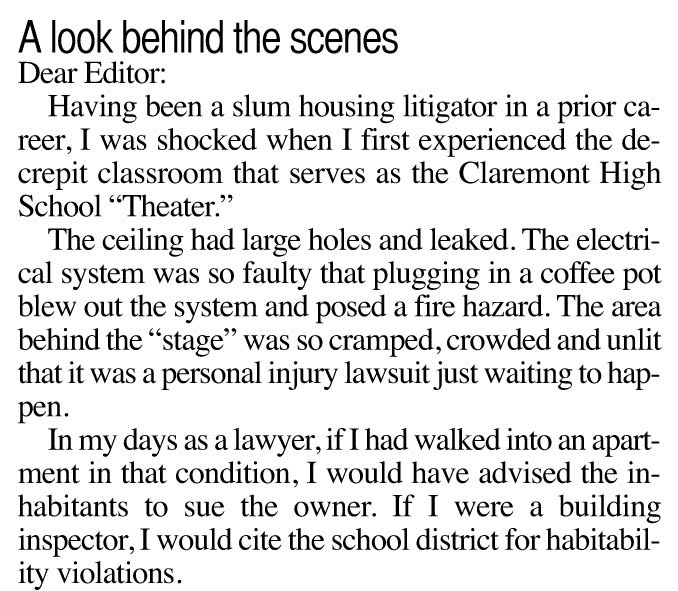
This campaign season they're at it again, telling Claremont Unified School District residents that we need to pass the $95 million Measure CL bond because our schools are falling apart. They tell us that our school buildings will collapse on top of our kids if we don't pass this bond. This past Wednesday, the Claremont Courier carried just such a letter in which Uncommon Good executive director Nancy Mintie compared the state of ClaremontHigh's theatre to a slum. Mintie writes with the famous Claremonster voice of authority, saying she was an attorney who fought slumlords, so she should know.
In her letter, Mintie went on to say that the sorry state of CUSD's facilities is proof that Claremonters should support the proposed school bond. But if we read Mintie's letter correctly, what she's really saying is that CUSD is a slumlord! Just like the slumlords Mintie opposed in the past, our school board and the district's admnistrators took the $48.9 million from the last school bond in 2000 and squandered it. They didn't pump all of that money back into fixing up their properties, and they neglected the young people who occupied those building. We clip the first three paragraphs of her letter, right. Buy the Courier to read the rest. Click to enlarge.
Following Mintie's argument to its logical conclusion, one should be compelled to deny CUSD access to any further bond money because they can't be trusted with it. But, this being Claremont, Mintie drew the opposite conclusion, despite her rather persuasive evidence to the contrary. Instead, Mintie said she supports this bond in order to fix our decrepit school facilities - precisely what CUSD and its supporters said the last bond was going to accomplish.
If Mintie were being truthful with us and herself, she'd say that CUSD needs to borrow more money because it mismanaged the last bond and didn't keep its promises from 10 years ago. But, as we've seen, the Claremonster capacity for deceptions of all sorts is limitless.
Only $1,050-$1,577 in Claremont Contributions: 1.6% to 2.4% of Total
$10,000 in fees (so far) to campaign consultant Jared Boigon and TBWB Strategies
$1,492.52 for Cell Phones!!!
The Campaign Finance Disclosure shown below is from the SupportClaremontSchools--Yes on Measure CL group. It just came our way. We will have comments later, but we are afraid they are going to be pretty obvious: Like, uh, where is the community support?
And what are they doing with fifteen hundred dollars worth of cell phones???
Answer: The Education Mafia--Piper Jaffray, WLC Architects, Flewelling and Moody, Northross Hill Ach, and Stradling Yocca Carlson Rauth. For these big businesses, this is just a business development expense.
The teachers or even the kids? Way down the list.
Grassroots Measure CL support? Minimal. Money from bond servicing firms and public school design and building contractors? Big. Really big. Which ought to be enough to tell you these businesses are just trying to buy their way to the public feeding trough, something they've done up and down the state.
If the very people footing the bill for a ballot measure are going to profit from it, that should be enough to tell voters to think twice. These companies aren't tossing in thousands and tens of thousands of dollars out of the goodness of their hearts. They're in it for the profit motive, and that doesn't necessarily translate into good public policy or fiscal prudence.
And you can bet that if Measure CL were to pass, those same campaign contributors would look to the bond to recoup those contributions. There is a lot of discretion in the bidding process, specs can be written a certain way, etc., etc., and so on and so on...
Read committee treasurer J. Michael Fay's report below. Download it. Print it. Pass it out to a dozen friends. Everyone in town should know just where the money for the Yes on CL campaign is coming from: CLYes460 Oct 1 2010
The debate over the Claremont Unified School District's $95 million Measure CL bond has raged in the pages of the Claremont Courier's reader letters section these past few weeks. Citizens on both sides of the school bond issue have used letters to the Courier as a sort of community forum.
The Courier itself seems to have slanted its coverage more towards the Yes on CL side, presenting an interview with members of the Yes on CL committee, taking readers on a CUSD-sponsored dog-and-pony show tour of Claremont High School, tossing in an article praising the district's test scores, as well as what amounted to an interview with Yes on CL's campaign consultant Jared Boigon of TBWB Strategies, who has been stage managing the yes campaign from San Francisco (at the cost of many tens of thousands of dollars, we might add).
Still, there not many other places to find both sides of CL the argument presented, the Courier did manage this past Wednesday to throw the No on CL group a bone by featuring an interview with their spokespeople, Donna Lowe, Opanyi Nasiali, and Jay Pocock. In a normal election year, our various local service organizations and institutions would be holding election forums where matters such as the November school bond could be debated.
For example, The Kiwanis Club, the Claremont Chamber of Commerce, Pilgrim Place, the Claremont Manor, Our Lady of Assumption Church, and Active Claremont all traditionally hold city council candidate forums, as they will next spring in advance of the March, 2011, municipal election.
The local League of Women Voters chapter holds the forum with the greatest cachet. It's usually one of the best attended of the candidate debates, and a good showing there can certainly help a prospective council member's chances of winning a seat.
Pros and cons on the nine California propositions for the Nov. 2 general election will be discussed at 2 p.m. Sunday Oct. 10 at the Claremont Public Library, 208 Harvard Ave.
The league and the Delta Sigma Theta Sorority Pomona Valley Alumnae Chapter will host a 59th Assembly District candidates forum. The forum will run from 7 to 9 p.m. Monday Oct.11 in the Padua Room at the Alexander [Hughes] Community Center at 1700 Danbury Road.
We would have expected the LWV, an organization that prides itself on its non-partisan efforts at educating voters on local, state, and national issues, to have been one of the first to offer both sides of the Measure CL debate to give their reasons why voters should be for or against the bond. This is clearly an issue that's generated a great deal of community interest and one that will affect CUSD property owners' pocketbooks for years to come. Yet, Measure CL is conspicuously absent from the League's fall election events.
Similarly, the Chamber of Commerce and other local organizations, including Sustainable Claremont, have endorsed the bond without giving opponents a chance to present their views. Whatever side one favors in the Measure CL election, all this lack of activity by our so-called communitarian organizations gives a good insight into how things work in our little, close-minded community.
As always, it's not what you know but who you know. It's a good ol' girls and boys network of the same circle of people running each and every group mentioned above, along with the Claremont Education Foundation, the Claremont Community Foundation, the Red Cross, and a host of other local charities.
The result is that opponents of any issues have an extremely hard time making their cases to the voters. Forums, by their very nature, require each side to have equal time. So even if the LWV tries to tailor the debate questions to the strengths of the people it favors, they still have to give opponents a chance to respond.
The absence of any school bond forums makes us wonder if the League and their fellow Claremont 400 organizations recognize Measure CL's weaknesses and are trying to help it by not holding any public debates. This goes along with the perception that bond's proponents are trying to avoid substantive discussions of the measure.
All of the Yes on CL mailings, for instance, speak in generalities, and the proponents, as well as the school board, have failed to offer up any specific details of how the money will be spent. For instance, the most recent mailings, which went out this past Monday and Tuesday, don't make any mention the $95 million price tag. And you'll never hear them talk about the $250 million total price after financing the bond for 40 years - an extra long payment schedule CUSD had to use to keep the payments per household at $45 per $100,000 of assessed value.
Further, CUSD has actually ignored public records requests and has withheld public information on the bond's financial details because they know that their own numbers will torpedo their arguments (another thing you won't hear about in the Daily Bulletin or the Claremont Courier).
The one organization that is holding a forum is Active Claremont. The AC school bond forum will be 7pm Thursday, October 21, in the Santa Fe room of the Alexander Hughes Center. Both sides will answer questions submitted by those in attendance.
By the way, Active Claremont, unlike the League or the Chamber of Commerce, is truly neutral, which probably explains why they're willing to host the debate. They don't endorse one side or another, they just let them talk. So let's stop giving false praise to those other groups for their community building efforts. The real communitarians in Claremont demonstrate their respect for all people and opinions in town through their actions, not their words.
As we indicated on Friday, the Claremont Unified School District's school bond campaign committee is looking to hire some able-bodied college students for its to work with its paid campaign consultant and its paid campaign manager in their "grassroots" Yes on CL effort.
We received a few emails from readers who were more than a little irritated by Yes on CL committee member Mike Seder's attempt at reaching out to his alma mater, Claremont McKenna College and CMC's Rose Institute, and we published a "Help Wanted" email from Rose fellow Douglas Johnson.
Johnson's email included this job description for the Yes on CL campaign manager position :
Campaign manager/field organizer – Claremont, CA, school bond measure.
Some political campaign experience or experience working with campaign volunteers preferred.
Irregular hours: >40 hrs/week through early November. Some evenings and weekends included.
Must have your own car. Laptop ideal but not necessary.
Responsibilities include, but are not limited to:
• Coordinating communication between members of the campaign team, including campaign consultant, superintendent & district officials, steering committee, volunteers, fundraising team and other community leaders and activists.
[CUSD's superintendent and district officials are barred from working directly on the campaign. Yet, according to the campaign's own job description, the district seems to be directly in charge of the campaign. Someone needs to file a complaint with the state's Fair Political Practices Commission. -ed]
• Under direction of the campaign consultant, implementation of a field campaign operation staffed by volunteers. Field operations may include volunteer recruitment, scheduling and training, voter registration, phone banks and precinct walks, vote-by-mail drives, lawn sign distribution, staging free media events and getting out the vote (GOTV) activities.
• Working with members of the fundraising team to mail invitations, request contributions, collect checks, write thank-you notes and hold events (if necessary).
• Coordinating with treasurer to ensure accurate and timely filing of campaign reports and other necessary forms.
• General day-to-day coordination and management of the campaign office, phone banks and other ongoing activities.
• Closing down campaign following election day, including the coordination of final fundraising reports, ensuring that campaign committee members and others are thanked appropriately and making arrangements to settle all outstanding campaign financial commitments.
The CMC connection for Mike Seder goes beyond his alumnus status. Seder's wife Diana is director of CMC's Career Services Center. As her CMC bio states, she "knows CMC and CMC students from start to finish."
Diana Seder Director Oversees all Career Services programs and events dseder@cmc.edu
Diana’s long-standing relationship with higher education administration started in 1987 when she graduated with her MBA from Claremont Graduate School and was hired by the same program to be their Associate Director. In 1991, she became the Acting Director of the Claremont Graduate School Office of Career Services, and then came to work at the CMC Career Services Center in 1997. Interestingly, at different times she has held both the Associate Director (Recruiting) and the Associate Director (Internship) positions as year-long assignments, so she is very familiar with the operations of the CSC. Diana assumes her role as Interim Director after an 8-year tenure with the Office of Admissions at CMC. “I know CMC and CMC students from start to finish” she says.
The Claremont Unified School District's Measure CL campaign team seeks students to work with a paid campaign manager to work on the Yes on CL effort.
Campaign committee person and Claremont 400 aspirant Mike Seder, whom we've seen on several occasions, is a graduate of Claremont McKenna College and, in his search for able-bodied campaign workers, seems to have been in contact with at least one person at CMC's Rose Institute.
This came in over the wire from a couple sources:
DATE: Wed, September 8, 2010 10:53:27 PM TO: Claremont Insider[claremontbuzz@yahoo.com] SUBJECT: FW: Claremont campaign openings
From: Douglas Johnson [douglas.johnson@cmc.edu] Organization: Rose Institute of State & Local Government at CMC Reply-To: [douglas.johnson@cmc.edu] Date: Tue, 7 Sep 2010 13:54:57 -0700 To: XXX Cc: Mike Seder [seder@fairplex.com] Subject: Claremont campaign openings
A friend from the Fairplex is deeply involved in the current campaign in support of a parcel tax to support Claremont schools. The campaign has a firm doing strategic consulting, along with a board of prominent local supporters, but they are looking for student volunteers and a paid day to day campaign manager.
Do you know of students (or student organizations) who might be interested in spending some time helping with this campaign to help Claremont schools, or who want to get some experience in a campaign at the grassroots level? This is a great way to do this without having to travel far from campus. If you know of anyone interested, could you encourage them to contact Mike Seder (seder@fairplex.com)? Mike's both a great guy and CMC Class of 1982. If they have questions, I'm also happy to talk to them and share what limited info I have regarding the campaign.
Obviously, time is tight as campaign day's approaching rapidly. Thanks!
- Doug
Douglas Johnson Fellow Rose Institute of State and Local Government Claremont McKenna College o 909-621-8159 m 310-200-2058 douglas.johnson@cmc.edu www.RoseReport.org
Johnson's email seems to support the notion that the campaign is driven by "a firm doing strategic consulting," no doubt TBWB Strategies and consultant Jared Boigon, who has advised the CUSD Board of Education from the very beginning.
It also struck us as very strange that a conservative organization like the Rose Institute would lend itself to campaigning for a highly dubious $95 million school bond (not a parcel tax, Doug). You'd think that with Claremont property owners still paying off $30 million of the last, misspent school bond, the Rose Institute would be ideologically inclined to question the wisdom of tacking on another $95 million in bonded indebtedness, especially when that new money amounts to little more than a blank check for a district that has repeatedly failed to demonstrate any fiscal commonsense.
But then, these are strange times.
* * * * *
Coming Soon: You may wonder what the job description looks like for the above position. Check back this weekend.
* * * * *
Our spies tell us that the Yes on CL campaign is casting quite a wide net in its outreach efforts. For instance, a couple weekends ago, a group of Claremont High School students who are against the bond were at the Claremont Sunday Farmers' Market handing out arguments against the bond. We hear that the kids had a volunteer sign-up list.
Who signed up to help on the "NO" campaign? None other than than the ever-subtle, pro-CL Ken Corhan (photo, left), who was summoned to the scene by CUSD board member Jeff Stark. Shilling for failed Claremont City Council candidates isn't enough for the ol' Kenster. This just goes to show that the Claremont 400 can be relied upon to run the same plays, over and over.
Leave it to Corhan to think he's so clever he'd be able to plant himself as a mole in a No on CL organizing party. Why can't he just be like the Insider and let the clandestine information come in over the transom unasked for? A word to the wise: When it comes to the Claremonsters, trust no one.
The Establishment finally came out with its much-ballyhooed List of Projects for Measure CL. This so-called "project list" is breathtaking in what it so obviously tries to hide from the voting public. In a few words, there is NOTHING there.
Attentive readers may recall that two weeks ago the Courier published Q and A article with the Bond Support and Promotion Committee, Bill Fox, Lee Jackman, and Mike Seder.
Even though Proposition 39, the law allowing this bond to go forward under the 55% threshold rules, requires that the July 22 ballot resolution by the school board be accompanied by a specific list of projects, well, there was nothing like a specific list. We commented on that issue in an earlier post.
Board member Jeff Stark opined at the July 22 School Board meeting that it was quite premature to expect a list; they needed to get a bond resolution first.
OK, but then the August 14 number of the Courier came out with the aforementioned article.
Courier:What are the specific projects and the estimated costs for each project?
Mr. Fox: "This project list is something that the district has been working on for a couple of years now. And this project list is something that our team--a committee within our team--is working on and narrowing down. So it's not ready to go out to the public yet because we've pared down a list that was $165 million to $95 million and we really are looking at what items on that list will reach the most children in the district."
There was a lame squawk about no project list in the August 18 Courier letters section.
In the meantime, the Mountain labored.
The August 25 number of the Courier contained a letter from Claremont teacher Dave Nemer castigating those with the impatience and impertinence to want some answers. He wrote in part:
Meanwhile, several recent letters to the editor have been critical of our school district because of the upcoming bond issue...The negativity expressed in the letters is unwarranted and based on little understanding of the facts involved.
The details of the bond plan have not been publicized yet, but naysayers have already denounced the plan anyway, preferring their preconceived judgments to informed reasoning...
Before we launch into impassioned debate about the new bond, it would behoove all combatants to wait until the details are announced.. Then we could proceed with a discussion based on actual information rather than ignorance and preconceived conclusions, for a change.
And still the Mountain labored but properly chastised, we waited patiently.
Finally, on August 28, teased by a 36-point all-caps headline on Page 1, above the fold, "NOW THE DETAILS", came what we all were waiting for.
Well, no.
The Courier didn't actually publicize the list, but we have it here. For ease of reading, we've broken it into two parts: the table proper followed by the notes. Click on the images to enlarge.
click images to enlarge
click images to enlarge
The money paragraph in the Courier article--in fact the only paragraph with actual cost estimates, reads as follows: "The current plan for the $96 million bond is to apply the funds in 4 main categories: repair and modernization ($48,412,886), technology ($22,189,862), sustainability ($14,395,562) and debt elimination ($10,000,000). The numbers are approximate figures representing an ongoing plan of spending."
That's it? No cost estimates? No numbers showing the balance among schools? Nothing other than a bunch of check marks? Where are the metrics? How do we measure performance? What is the District actually planning to do?
From the Courier:
Estimates for individual items on the project list were unavailable. Mr. Fox said the estimates for each section were based on looking at the needs of the Claremont schools.
"A estimate [sic] of each item would be done after the bond has passed," he pointed out. "There would need to be architects and project managers that would have to be hired by the district to come out. [Does this guy really talk this way? Re-read the last sentence. We have quoted it correctly. "There would need to be architects...to come out" ???] That is a very costly step and the district would have to use part of the bond money to do that."
So this is the mouse the Mountain labored over: Wait until the bond passes and we will tell you then.
We actually think this spreadsheet had to have come from a version that at one time had numbers in the grid, and like a clumsy FBI-redacted document the author or committee scrubbed the page of any incriminating information. Really, does it make any sense to have a grid, with "totals" column, and subtotals placed just above each group, and precision to eight significant figures, if a prior version didn't have numbers where all we have now are check marks?
We guess the committee, the school district, and the consultants don't really believe all that much in transparency.
By the way, when searching for the author of the "project list", whether it was Bill Fox, or Lisa Shoemaker (the head of the CUSD business office), or Terry Nichols, the Superintendent, or ???, we found an interesting fact. In the Adobe PDF "Properties" the author is saved. And who authored this masterwork?
Look at what we found:
And who is Jared Boigon? CUSD's high priced communications consultant. The priorities are not even set by the committee, they are set by a consultant in San Francisco! Either that or he is the World's Most Expensive Committee Secretary! Mr. Boigon is a Partner at TBWB Strategies--Public Consensus; Winning Propositions. He's not an educator nor a finance guy nor even a construction expert. He's a political hack. Read here about his getting his mother elected to the Denver City Council.
* * * * * * *
The report can be found on the supporters' website, here.
The Insider has learned that the circle of people officially associated with the Yes on Measure CL campaign has widened from the original three - Bill Fox, Mike Seder, and Lee Jackman - to include insurance agent and Claremont 400 heavyweight Randy Prout, former Claremont United Church of Christ pastor and current city Human Services commissioner Butch Henderson (photo, left), and former Human Services Chair Suzanne Hall, wife of the ubiquitous Ken Corhan.
We shouldn't be surprised to see Prout or Henderson or Hall/Corhan, popping up in the Measure CL campaign. All were associated with the 2005 Preserve Claremont campaign that tried to derail the candidacy of Claremont city council member Corey Calaycay. We should also remember that the PC campaign was as much about censoring council member Jackie McHenry and keeping then-City Manager Glenn Southard in charge as it was concerned with barring Calaycay from the council.
That the current school bond campaign and its supporters don't mind twisting the truth shouldn't come as a surprise either. During the 2005 city council election and after, Henderson, who seemed to use his position in our town's main church to unduly influence people to support the Claremonsters' agenda, was a spokesperson for the Preserve Claremont campaign and was quoted in the Claremont Courier on 2/19/05. In that article, Henderson admitted not only that his campaign employed manipulative tactics, but that such games are a natural part of any political campaign, even one involving the Claremont UCC's head pastor:
Mr. Henderson responded to a complaint he had heard that the [Preserve Claremont] ads were "manipulative".
"Of course they are," he said. "That's what politics is all about. Claremonters like things to be real nice. They say, 'Let's do powerbrokering behind the scenes and be real nice.' But politics is about leaders. Mr. Calaycay s running for office and we're trying to get factual information out about him."
Click on Images to Enlarge
It mattered not a whit that the "factual information" Henderson alluded to consisted of nothing more than rumor, innuendo, and outright lies, much of which was supplied by city staff. But, rather than being shocked that a former man of the cloth would engage in such self-acknowledged manipulations, we should expect it.
We can't help but recall the last Claremont Unified School District Measure Y bond campaign in 2000. During that lead up to that campaign, school district officials held a public meeting at which residents who lived near Claremont High School showed up to protest the planned use of Measure Y money to put a football stadium in at the high school.
When it became clear during the meeting that the football facility plans were going to imperil Measure Y's passage, the district officials took a break, held a quick sideline huddle with Superintendent Keeler calling signals, and then reconvened to assure the audience that no Measure Y dollars would be used for the high school stadium. At that meeting, one Butch Henderson, who happened to live very near the high school, stood up and said he was happy with the district officials' plan to accommodate his neighbors.
With no opposition from the Towne Ranch neighborhood, Measure Y passed by a little more than 100 votes citywide. Within a matter of a few years, the district, flush with Measure Y dollars, installed the permanent football field, lights, and bleachers at the high school. In fact construction workers are installing a second course of permanent seating right now.
So, yes, the neighborhood was lied to. But in Claremont anything associated with the school district approaches a certain religious fervor, complete with a kind of priesthood to deliver CUSD's holy word. The truth is whatever that priesthood says it is. As Pastor Henderson could tell them, all's fair in politics and war.
The Insider's investigative arm has been hard at work trying to confirm some information that came in over the transom last week regarding the $95 million Measure CL bond the Claremont Unified School District put on the November ballot. The information would seem to confirm our original hunch that the bond proponents will be following a very familiar game plan for the bond.
You may recall that one of the problems with school district's the bond measure is that they're asking for a boat-load of money without explaining how they intend to spend this. In its bond resolution's fine print, CUSD said that if you wanted to figure out what the projects in question are, you had to consult the district's Facilities Master Plan, an inches thick black binder kept at the school district's offices.
We're hearing that the Master Plan contains a copy of the following document in a pocket on the inside of the binder:
This document is a campaign consultant's template for a generic school bond campaign. It's a concern because CUSD isn't supposed to be be campaigning in favor of the bond. Yet, there the campaign template is, or was, sitting in a district binder. The district will no doubt have the document removed as quickly as possible, but as you can see above, we still managed to obtain a copy.
But is the district really planning on using this road map in the present campaign? It certainly seems thus so far. There are some noteworthy suggestions listed in campaign consultant's document - suggestions the Yes on Measure CL campaign seems to be following closely.
For instance, Item 4 on page 1 of the template suggests that campaign funding should include the district's vendors and that the amount of money those vendors donate can be tied to their volume of business. In other words, the district is saying, "If we've got you under contract, you should kick in a dollar amount commensurate with the amount of work (and money) you're getting from us.
Item 4Vendors who do business with the District also see value in helping the District become stronger in serving the children of the community. District staff members working on their own time can help in this area. See Exhibit 2. Note that contribution goals can be set per volume of annual business with [the] District [emphasis added - ed.]
As with CUSD's 2000 Measure Y bond, the district's surrogates will hit up those vendors for big donations. In 2000, the bond supporters raised over $80,000, the majority of which came from CUSD vendors. They'll do so again and will go over $100,000 if they stick to their usual methods.
On page 7 of the document, we see a sample ballot argument. Precisely the same talking points the Measure CL proponents have used are listed in this sample:
The bond will "provide funding for Classrooms and Facilities." Our district keeps saying that, even though they have admitted that the money will go towards restoring faculty health benefits and reimbursing the district for the time spent by its staff on bond projects.
None of the funds will be used for administrator salaries. The Measure CL bond resolution approved by the CUSD board makes exactly this statement. Yet, as noted, they have also publicly said the money will go to salaries and benefits.
Reasonable cost - $1.00 a day. Isn't this the $365 campaign that was pushed by the Claremont Educational Foundation? Say, if you happened to get on the bus with your $1 a day donation, and then the district succeeds with the bond, you could easily end up paying double that $365 once the bond assessments are made.
The district has created a bond oversight committee to ensure bond funds are spent wisely. Yes on CL committee leader Bill Fox keeps reminding people of that oversight requirement. But he keeps leaving out the part about the last bond oversight committee failing to keep accurate tabs on how the money was spent.
Beginning on Page 11, the document lays out a direct mail campaign with estimates of the voter turnout and the number of votes needed to win. The targets of the mailings are divided into six groups, each with its own specific content.
A couple points of interest here. The district's consultants recommend mailing to property owners a message that gives each homeowner an estimate of their individual taxes for the bond based on county assessed values. The property owner mailing, though, has a ceiling set on the assessed property values. In the consultant's example on page 14, they said they will exclude mailing to voters with assessed value of more than $150,000.
In these times in Claremont, that number might be closer to $400,000. The consultant appears to be trying to conceal how much their bond will affect people with homes above a certain value because they might find the bond prohibitively expensive.
The district's consultant doesn't stop there. Page 14 also lists a mailing to be sent to non-property owners. The pitch to them? "Measure A [the example in the report] costs you nothing." So, despite the district's claim that renters end up paying for the bond, they tell those renters the opposite. The district tells them to not worry, they'll get a pass on any bond payment, so they should vote for it. It's a free ride, the consultant says.
We also learn that the mailings don't come cheap. The consultant's projected budget on page 10 lists $31,000 for direct mailing and, naturally, $30,000 for the campaign consultant. Those two budget items account for $61,000 out of a possible $80,000 in campaign contributions for the hypothetical bond election.
The consultant also recommends getting other local officials (council members, county supervisors) on board, as well as police associations, business men, contractors, vendors, unions, and realtors.
All of this gets us back to the fact of the district having a sample campaign strategy and spending plan stored in its Facilities Master Plan binder at the district office. By law, the district is supposed to refrain from directly participating in campaigns. Yet, let's not forget that the district paid $25,000 for the consulting company TBWB Strategies to conduct a poll that was turned over to the Yes on CL campaign, which consists of the same three people that earlier this year worked together on the district committee that came up with the recommendation to go forward with a bond.
Is it any wonder why we keep thinking the bond was always the goal and that district all along intended the TBWB poll to be used to poll-test bond arguments with voters? CUSD seems to skate awfully close to the line of electoral propriety with some of their actions.
According to the district highlights for its 6/3/10 meeting, the president of the teachers union is even listed by name in support of the district's bond idea:
Superintendent Nichols provided background on the Bond/Parcel Tax Survey Committee and asked Jared Boigon, TBWB, to provide an update on the Bond/Parcel Tax Survey. Mr. Boigon shared highlights from the survey report and committee members, Lee Jackman, Bill Fox, and Mike Seder provided additional background and outlined the committee’s recommendation. Joe Tonan, incoming CFA President shared the association’s support for the committee’s recommendation. Staff and Mr. Boigon responded to Board questions and the Board requested more specific information on a timeline and next steps and requested a defined project list that included staff and committee priorities. This item was for Board information and discussion and no action was taken.
Their actions underscore the reality that CUSD, its board, the bond campaign committee, and the leaders of the Claremont Faculty Association seem to unlimited quantities of contempt for voters, for the spirit of the election rules they should be obeying, and for truth in their campaign statements.
You don't have to be a super-sleuth to get to the heart of the bond matter: If the district is already acting in less than forthright ways before the bond has even been voted on, why should anyone trust them with the $95 million they're asking for?
Update--Sunday, August 22. See end of post in red.
In June, when the Claremont Unified School District was still negotiating with the Claremont Faculty Association, Wes Woods II had an article in the Daily Bulletin about the heated nature of the contract talks.
One interesting point that came out in Woods' article was the amount CUSD spent on the law firm that represents the district:
The school district's Los Angeles-based law firm, O'Melveny & Myers, also has been an issue for the union. Tonan said the firm spent about $149,000 in reduction in force hearings in 2008-09, while the union's firm spent about $28,000.
A union flier was shared with the media, union officials and the school district that indicated Claremont Unified's attorney Framroze M. Virjee (image nearby) was paid $765 an hour for every hour he was at the bargaining table. Virjee's law firm, O'Melveny & Myers, was paid more than $535,000 in 2008- 09 and more than $365,000 in 2009-10 by Claremont Unified.
That's right. CUSD spent $900,000 on legal expenses in the past two years. That's almost 1 percent of the district's November Measure CL bond, and you can bet that some of the money the bond generates will somehow end up compensating the district for their legal expenses.
As we're discovering, there's real profit (or cost to taxpayers) to be found in the education business, at least in consulting and contracting work. In return for those expenses, administrators and teachers alike avoid the level of sacrifice they ask property owners - the ones footing the bill - to make, and the elected school board officials get to continue to play their self-indulgent fiscal games. The trade off is that schools are more expensive to run but are in no substantial way better than they were last year or the year before that.
It's a little like the inverse of Moore's Law. CUSD's costs relative to performance are falling. Or maybe it's just a manifestation of Baumol's cost disease.
* * * * *
A couple quick comments:
Since Woods' article in late-June, CUSD and the CFA have agreed to a contract that calls for the union to accept larger class sizes in the middle and high school grads and to concede $1.58 million in health and welfare benefits over the next two fiscal years. In exchange, the union has agreed to support the November Measure CL bond with the understanding that they will get their former benefits back if the bond passes - an arrangement that allows both parties to circumvent the law requiring such school bonds to not be used for administrative or teacher salaries - at least, that's what CUSD officials have said.
O'Melveny & Myers is a true legal heavyweight. The firm, which is the 19th largest in the world, has for partners such luminaries as former Reagan White House Counsel Arthur B. Culvahouse, Jr., and former Clinton Administration Secretary of State Warren Christopher.
Claremont is more than a little familiar with O'Melveny & Myers. Former CMC trustee Louis Caldera, who served as U.S. Secretary of the Army from 1998 to 2001 and who lost his most recent White House job in 2009 after a PR flap, is an O'Melveny alumnus. And CMC retained O'Melveny to conduct an investigation into the Nazi stolen art controversy involving CMC history professor Jonathan Petropoulos a few years ago.
Update, Sunday:
Saturday's Claremont Courier touched on this issue. On page 5, The Courier describes an offer at last Thursday's School Board meeting by Marcie Gardner, a Chaparral parent, to help look for a cheaper law firm. As an aside, that ought not to be too hard.
Gardner is quoted, "One area that seems out of control within the district is legal fees, and I say that because I'm a lawyer and I have quite a bit of experience with things related to education. The hourly rate that is being paid by the district for an attorney is double and sometimes triple the going rate of what these services would cost in the open market." [emphasis added]
We also received a cryptic email from a reader on this general topic, and we can't help but read it as also casting aspersions on the ol' Insider:
The reader writes:
900,000 is a lot but how much of that 900,000 was tied to defending Tonan's personal lawsuit against the district? How much was tied to the negotiations that were dragged out to ridiculous lengths only to be settled after Tonan's lawsuit was settled? A settlement, mind you, that could have been reached 6 months ago if it were not for Tonan's conflict of interest.
There is more out there that you are ignoring. I'm wondering if it's intentional.
--Outside Claremont We asked for additional info, and the reader was good enough to give us one specific that appeared on page 6 of the 2010-2011 Claremont Courier Almanac, sent with the paper a week or so ago (our reader refers to the personal lawsuit between the Tonan family and the district):
Settled for 75k I heard. Settlement between the union, that Tonan heads, and CUSD came immediately afterwards.
One view is the Tonan dragged this out, at great cost, until the issue with his wife was settled...
--Outside Claremont Notice the walk-back from the main point: "One view is..." Our reader isn't even saying that's what he believes. We hold no brief for Joe Tonan or the merits of his case. The fact is, we never understood nor were given a cogent story on the Cynthia Estep-Tonan dismissal. It seemed both sides were scurrying for cover and obfuscation in that one. (to readers who don't know what we're talking about, we don't blame you. You'll have to look at back numbers of the Claremont Courier from Spring 2010 to see articles on the brouhaha accompanying Ms. Estep-Tonan's dismissal as a school nurse by CUSD.)
Anyway, the reader makes a valid point by inference. Total district legal cost equals average hourly rate times number of billed hours. Ms. Gardner says the average hourly rate is too high; our reader implies that the number of billed hours is higher than necessary.
Both are easily within the control of the School Board: Hilary LaConte, Jeff Stark, Mary Caenepeel, Beth Bingham, and Steven Llanusa. Get a less stratospheric attorney and don't get involved in labor disputes where you are having some one like good old Fram (see above) bill you north of $700 per hour and then have to write a check to your employee for $75K.
Our daddy always told us that the party that had to write the check was the party in the wrong.
We had a couple emails come in that warranted posting.
The first was a note about our post from last Wednesday on the Claremont Unified School District's and school board member Jeff Stark's tendency to obfuscate:
DATE: Thu, August 12, 2010 10:44:03 AM SUBJECT: and it's just that simple TO: Claremont Buzz
"...at the July 22 school board meeting, Jeff Stark (apparently the voice of authority on the bond issue) claimed it would take a long time to get that information....
"The assessor's report for 2009 on page 28 of the PDF file lists the assessedvaluation for the city of Claremont as $3.55 billion."
I love how well you do that, and I know why it pisses people off. Never stop.
By the way, after reading that email, we noticed an error in Wednesday's post. The page we referenced from the LA County Office of the Assessor's report was page 16, not page 28. We've corrected that mistake.
* * * * *
Then there was this from a reader who wanted to set us straight on the matter of now-retired Indio city manager Glenn Southard. Earlier, we speculated that Southard's annual pension might be significantly larger than his final year's $300,000 salary. We thought that Southard might be able to use some of his $162,000 in unused vacation and sick time towards the number used to determine his CalPERS pension.
The reader, who has a good deal of expertise in municipal retirement finances, says that we were in error when we indicated that Southard could have used any bonuses, vacation, or sick time to enlarge his retirement. The reader also states that Indio's own finance director would have been ethically bound to advise the Indio council of the improprieties of allowing Southard to count such extras towards his retirement payouts.
The reader goes on to say that the real budget buster for municipal pensions is public safety workers (police and firemen). The reader makes a number of good points there that are very much overlooked, by us and by others who follow public pensions.
Here's the reader's letter:
DATE: Wed, August 11, 2010 11:40:32 AM SUBJECT: CalPERS fact check TO: Claremont Buzz
A couple of things you did not get quite right. I'm no fan of Glenn Southard, but your article does have some factual errors. As to spiking, CalPERS is pretty good about not allowing it, unless the City Council is complicit in the spiking scheme (ala Bell). Overtime, bonuses, and sick leave and vacation payouts are NOT used to determine final compensation. The only way accrued sick, and vacation time could be used to spike the final years salary, is if the City Council approved, a salary increase, in lieu of paying out the accrued leave, That would have to be done at a public meeting, and if found by CalPERS would result in the benefit being reduced. CalPERS finding it, and doing something about it (as in Bell) is not likely. But a City's finance director, would know that this is a prohibited practice, and would be ethically bound to advise the Council against taking such an action.
Now, a great CalPERS/ public safety union scam has to do with police and firefighters. Uniform allowances, education pay, and special assignment pay (like being a detective, or a truck captain) are counted as part of final compensation, which is paid at about 98.6 % in retirement starting as early as age 50. Where else can you get paid after retiring for uniforms you don't wear, a speciality bonus for work you no longer do, and for getting an education which allowed you to advance through the ranks, to the level of pay at which you retire at. And if you are a firefighter you get paid to sleep, and as a police officer you get paid for your meal times. This is were the pension system is bleeding. Oh, and guess what. CalPERS has recently completed new actuarials on age. The average public safety worker will live to 82.5, while the average general employee lives to about 81.7. This finally answers the myth that police, and firefighters don't live very long after retiring--therefore they should get better pensions.
You really ought to look into this, instead of focusing on management, as public safety retirement benefits are what are creating the large unfunded liabilities.
I should know. I am a former finance director for a large California city.
We stand corrected, though we are still puzzled by a couple things. The Claremont Courier's Tony Krickl reported last week that Southard's retirement payments, according to Indio's records, were $309,000 a year. Since this is above his final contract's salary, something must have been added in.
We looked at another blog's post that showed a 2007 amendment to Southard's Indio contract (posted here). Included with that contract amendment was a letter from CalPERS regarding Southard's retirement that states: "69.625 days unused sick leave have been credited to the member's account. If all of this information is correct, no action is needed." The letter was dated March 18, 2010. So at least some portion of that sick leave appears to have been used to bump up Southard's pension.
One other point. In Indio, Southard's finance director was Michael Busch, who had the same position under Southard in Claremont. We can't speak to his ethics, but Busch was always a Southard yes-man. We don't see him opposing anything that would benefit Southard.

 That's with 94% of the Claremont school district precincts reporting and only 2 out of 35 precincts left to report. (Now Final) We won't comment further at this point, other than to say that CUSD will be back with another bond or parcel tax. Let's see if they are willing to include the wider community the next time around, or if they will play the same ol' overreaching Claremont game with consultants like Jared Boigon coordinating things and getting hundreds of thousands from school contractors.







 Posts
Posts


