It turns out the Claremont 400 are pretty small potatoes compared to the shadowy figures controlling the levers on the national level. So says The Onion:
Diebold Accidentally Leaks Results Of 2008 Election Early
Of course, in Claremont, all you need to do to know who's supposed to win an election is to drive by Diann Ring's or Judy Wright's home and check out the campaign signage. Here's a prediction for 2009's March council election, when two seats will be up for grabs: Ellen Taylor and Not Calaycay (Bob Tener?).
Showing posts with label Bob Tener. Show all posts
Showing posts with label Bob Tener. Show all posts
Saturday, March 1, 2008
Shadow Government News

Sunday, February 24, 2008
This Week's Meetings
 COUNCIL CLOSED SESSION MEETING
The Claremont City Council will be holding another of its closed session meetings this Tuesday at 5:15pm.
The meeting will be in the City Council chambers at City Hall, which is located at 207 Harvard Ave. in the Claremont Village. As usual, the closed session will precede the regular council meeting.
The closed meeting will allow the council to discuss the possible purchase of the Golden State Water company's water utility for Claremont. Price and terms will be the topic of the discussion.
COLLEGE PARK LIGHTING
And the winning bid is... Musco Lighting Company of Muscatine, Iowa.
At least, that's city staff's recommendation to the city council this week for the 6 new sports lighting standards at baseball field #2 in Claremont's College Park. That award of the lighting bid is on the agenda for Tuesday's regular council meeting, which begins at 6:30pm.
No surprise here. Not that Musco's products are necessarily the best or most cost effective. Mayor Peter Yao had asked staff for an comparative analysis of the Musco lights with other products, including those manufactured by a company called Softlite Lighting Systems, but staff gave their usual thumb to the nose response to Yao's request for information.
Musco is the big dog among sports light manufacturers, but control of market share does not necessarily mean that any company produces the best product - just ask Mac users if a PC is a better computer.
Musco's size and sales force does enable them to provide certain services like "expert" lighting studies for project environmental impacts reports, such as the one they did for Claremont's Padua Park. It isn't really surprising that once Musco's experts make their findings, that their lights find their way into city parks.
Musco's sports lights, by the way, may not necessarily be the best product to fit Claremont's new sustainabilty push, but of course the people pushing that initiative, such as Planning Commissioner Bob Tener, have remained typically silent on what has to be the city's single largest electrical expense.
The staff report states that Musco was the lowest "responsive and responsible" bidder. Only one other company, Qualite-Mark V Design, was listed as having bid on the College Park lights.
Qualite-Mark was actually lower than the Musco bid ($47,856.65 vs. $50,132.74), but apparently Qualite-Mark ranked lower in responsiveness and/or responsibility. Or so says the staff report by Claremont Human Services Director Jeff Porter. No word on how the Musco lights compare to other products in terms of spillover, glare or energy efficiency, all things that one would think the city's sustainability task force ought to be concerned about.
If you are curious about this, ask about it Tuesday night. You're sure to get that special, assuring Porter fast talk. Don't expect any real answers though.
Musco's sports lighting standards do offer one thing that other companies' products apparently don't: They can be used for cellular phone towers. Look for more of these things in Claremont city parks in the future.
AFFORDABLE HOUSING TASK FORCE
The city's affordable housing task force is also on the council's agenda for Tuesday. The task force's job will be to identify possible affordable housing sites now that the Base Line Rd. project is on hold.
The staff report on the subject is signed by Tony Witt and Brian Desatnik, two holdovers from the Glenn Southard-era in Claremont. Witt and Desatnik say that Councilmembers Linda Elderkin and Sam Pedroza want to be on the two-person Ad Hoc Committee to interview prospective task force members.
Don't be surprised Elderkin and Pedroza to freeze out people who had been opposed to the Base Line Rd. project and to load up on their cronies. We suspect the two haven't learned a thing about coalition building and want to punish the Base Line Rd. project opponents by not allowing them a voice on the new task force.
Now, tell us if this makes any sense to you. A faulty project is pushed by a group of Claremont insiders (small "i") who refused to listen to any voices outside their little group. The project fails as predicted. An ad hoc committee is then formed and stocked with the same people responsible for the initial, failed project to the exclusion of alternate, more reasonable voices.
Does anyone see another trainwreck coming?
COUNCIL BUDGET WORKSHOP
Finally, for you policy wonks out there, the City Council will hold a special budget workshop on Wednesday, February 27th, at 6:30pm. The meeting will be held in the college room of the Alexander Hughes Community Center at 1700 N. Danbury Rd.
You can read more in the meeting's agenda packet.
Monday, February 18, 2008
Send in the Clowns - UPDATED
 "This really is not a circus."
- Claremont Mayor Pro Tem Ellen Taylor, speaking at last week's City Council meeting during a discussion on the Base Line Rd. affordable housing project.
WRONG. Queen Ellen had it exactly backwards. This and every contentious issue that's come before the Claremont City Council since at least 1988 is a full-on three-ring circus.
Call it Cirque du Claremonsters.
We've called this thing a train wreck before. We just didn't know it was a circus train.
Saturday's Claremont Courier had an article by reporter Tony Krickl about last Tuesday's City Council meeting. As the article noted, the Claremonsters are not content to let the matter die and move on. [UPDATE: The Courier article is online now.] Led by Ellen Taylor, Claremont League of Women Voters president and Claremont Police Commissioner Barbara Musselman (aka, Miss Personality), and Claremont Human Services Commissioner Andy Winnick, the increasingly small faction of Claremont 400 members backing the Base Line Rd. project were arguing that the city should question the legality of the L.A. County decision to not allow county funding of affordable housing projects within 500 feet of a major highway - a move that effectively killed the Base Line Rd. site as a viable affordable housing location.
During the meeting, Queen Ellen ordered her loyal retainer, city attorney Sonia Carvalho, to see if the L.A. County Community Development Commission (CDC) violated California's Brown Act sunshine law in making that decision. Taylor and company also hinted a dark conspiracy of county representatives who wanted to thwart the Claremonsters' affordable housing plans.
Such is the Claremont 400's outsized self-image of their town that they imagine that a county of over 10 million people would choose to scheme and skulk around in backrooms in order to single out one very small town of 35,000 people on the county's far eastern fringe.
The same group headed by Taylor has made similar arguments regarding the USC School of Medicine study that was published in the Lancet medical journal last year. That study formed the basis of the county funding policy change. Using Taylor's twisted reasoning, the USC researchers, using their evil prescience, knew 11 years ago that they would have to conduct their study in order to put a halt to the Base Line Rd. project.
Taylor, Musselman, and Winnick would have us believe that the researchers then falsely obtained grant money and 11,000 test subjects in order to justify their spurious findings, which they then handed over to the L.A. County CDC to cut off the funding for the Base Line project. All of this kooky thinking really explains many of the Claremonsters' past actions. They actually believe that Claremont is the center of the universe. No wonder Claremont Heritage's map of the town (pictured at left) seems to lack a proper sense of scale.
We've preached the need for humility before, and the affordable housing issue certainly illustrates how the absence of that quality causes us no end of trouble.
So, now, instead of focusing on finding a viable alternative for the project they say is vital to Claremont, Queen Ellen and her court want to spend staff time and resources proving their odd, conspiratorial theories, mostly because they cannot admit they were wrong.
Citizen Michael John Keenan had the best commentary on this red herring. Keenan and remarked on the Brown Act question. He brought up the City Council's closed session decision last year to spend $1 million from the city's General Fund reserve to make up for the $1 million state of California grant that was denied Claremont for the purchase of Johnson's Pasture.
Keenan was basically saying, "Claremonsters who live in glass houses...." You go, Michael!
Look for more silly council behavior in April, when Queen Ellen succeeds current Mayor Peter Yao.
* * *
 There were more than a few notable absences at last Tuesday's meeting. Claremont 400 candidate-to-be, Planning Commissioner Bob Tener, has apparently gotten off the Base Line project train. No dummy he, Tener knows a dog when he sees one, and he no doubt doesn't want to be too closely associated with a loser. Wouldn't want to imperil your run at a council seat, would you, Bob?
The League of Women Voters point person on the Base Line project, Karen Vance, was also not at the meeting.
* * *
Saturday's Courier also carried a "My Side of the Line" op-ed piece by Courier editor Rebecca JamesCourie, who didn't mince words on the Base Line Rd. issue:
Let’s take the blinders off and direct staff to look for other viable locations. The old COURIER site certainly has our vote. Although we were loath to give it up, we consider the location to be ideal for affordable housing. Youngsters could walk to school, parents could walk to markets and the need for transportation would be minimal. Not to mention they would be right by the Metrolink to take them to other locations.
As far as the Baseline Road site is concerned, write the check! Please write the check, give it to the redevelopment agency and get on with it! Let the police department have their much-needed and larger facility. We have truly given this project too much of our time. It has become a political volleyball that has been tossed around for so long that it has become ridiculous. The idea of affordable housing is certainly relevant. Let’s make it workable.
Hear, hear! We would also add that if the city does go forward with a citizen's committee to look at alternatives to the Base Line Rd. project, they must take care to select a committee that includes people who were opposed to the Base Line Rd. project.
The Claremonsters have falsely claimed that the project opponents were NIMBYs (shorthand for Not In My Backyard). The 400 loves to pin the NIMBY label on anyone who questions one of their project. Now that the 400 have lost, though, they should forfeit the right to have exclusive control over the choice of an alternative. They screwed up the last one, what would lead us to believe they can be trusted to do any differently this time around?
Moreover, the equation the Claremonsters posit, opposition to the Base Line site = opposition to ANY affordable housing, is a lie. A number of Base Line opponents have expressed a desire to participate in the alternatives committee, and they should be welcomed into the process.
Let's see the 400 put their money where their mouths are. If the "process" is really fair and open, anyone who wants should be allowed to participate. Maybe then we can forestall the faulty decision-making that has plagued us for far too long.
Tuesday, February 5, 2008
Walk Scoring Claremont
I'm walkin', yes indeed I'm talkin'....
- Antoine "Fats" Domino

Centinel over at the Foothill Cities Blog turned us onto a website called walkscore.com where anyone can measure the walkability index of any given location in the U.S.
Walk Score explains its raison d'être:
Why Walking Matters
Walkable neighborhoods offer surprising benefits to our health, the environment, and our communities.
Better health: A study in Washington State found that the average resident of a pedestrian-friendly neighborhood weighs 7 pounds less than someone who lives in a sprawling neighborhood. Residents of walkable neighborhoods drive less and suffer fewer car accidents, a leading cause of death between the ages of 15 - 45.
Reduction in greenhouse gas: Cars are a leading cause of global warming. Your feet are zero pollution transportation machines.
More transportation options: Compact neighborhoods tend to have higher population density, which leads to more public transportation options and bicycle infrastructure. Not only is taking the bus cheaper than driving, but riding a bus is ten times safer than driving a car!
Increased social capital: Walking increases social capital by promoting face-to-face interaction with your neighbors. Studies have shown that for each 10 minutes a person spends in a daily car commute, time spent in community activities falls by 10 percent.
Stronger local businesses: Dense, walkable neighborhoods provide local businesses with the foot traffic they need to thrive. It's easier for pedestrians to shop at many stores on one trip, since they don't need to drive between destinations.
And here's how they figure their scores:
How It Works
Walk Score helps people find walkable places to live. Walk Score calculates the walkability of an address by locating nearby stores, restaurants, schools, parks, etc. Check out how Walk Score doesn't work.
What does my score mean?Your Walk Score is a number between 0 and 100. The walkability of an address depends on how far you are comfortable walking—after all, everything is within walking distance if you have the time. Here are general guidelines for interpreting your score:
How it Works
Walk Score™ uses a patent-pending system to calculate the walkability of an address based on:
Centinel typed in the address for Pasadena City Hall and got a walkability score of 98 out of 100.
We picked up Centinel's idea and thought we'd apply it to Claremont's Base Line Rd. affordable housing project, which is on its deathbed begging for a Do Not Resuscitate order.
We went to walkscore.com and first entered "Towne Ave. and Base Line Rd., Claremont, CA," the rough location of the Base Line Rd. project being pushed by the Claremont League of Women Voters, Mayor Peter Yao, and Mayor Pro Tem Ellen Taylor. Walk Score kicked out a walkability index of 19 out of 100 for the project area - a very poor score:
We picked up Centinel's idea and thought we'd apply it to Claremont's Base Line Rd. affordable housing project, which is on its deathbed begging for a Do Not Resuscitate order.
We went to walkscore.com and first entered "Towne Ave. and Base Line Rd., Claremont, CA," the rough location of the Base Line Rd. project being pushed by the Claremont League of Women Voters, Mayor Peter Yao, and Mayor Pro Tem Ellen Taylor. Walk Score kicked out a walkability index of 19 out of 100 for the project area - a very poor score:
Click on Image to Enlarge

In contrast to Towne Ave. and Base Line Rd., typing "111 S. College Ave., Claremont, CA," the old Claremont Courier building location and possible alternate site for the affordable housing project, produced a walkability index of 89 out of 100, an almost ideal total on the Walk Score scale:
Click on Image to Enlarge 
So, for all their talk about sustainability (that means YOU, Bob Tener), by insisting on jamming the affordable housing project into the Base Line Rd. site, the Claremont 400, the Claremont's League of Women Voters, and the City of Claremont are demonstrating through their actions that they aren't really interested in reducing car trips, encouraging use of mass transit and walking, or helping local businesses by placing new, denser housing near the areas with the most shopping and restaurants - all those things that are aspects of REAL sustainability.
It's time, we think, for them to put their money where they mouths are.
Sunday, January 20, 2008
Sunday Mailbag
 A reader wrote in with some tips on how motorists ticketed by the Claremont Police Department for honking in support of anti-war protesters should deal with the citations. Like us, the reader didn't think using the First Amendment as a defense would get very far when it comes to Claremont:
Traffic court judges rubber-stamp everything that makes it into the courtroom -- traffic court is principally a revenue-production factory, and anyone walking in with constitutional arguments about freedom of speech is going to be cut off about three seconds into their comments. But I beat an illegal Claremont speeding ticket by paying $350 to a lawyer to file a demurrer -- it makes victory much more likely, and pays for itself in stable insurance premiums. A demurrer is a claim that even if you did what the police say you did, it wasn't illegal, so the matter shouldn't be before the court. The judge takes it up outside the regular traffic court session, and the city has to respond in writing and send a lawyer if they want to prevail. I went to Antonio Bestard, across the street from the courthouse. My bet is that these folks will lose without a lawyer, and win with a lawyer. FWIW.
Oh, and trying to get the city to agree to dismiss an unlawful citation? No. I still have a letter from what's-his-name, the last police chief (whose name I tended to forget even when he was still on the job), acknowledging that the citation I had received had been issued contrary to the provisions of the Vehicle Code. He suggested that I tell it to the judge. They don't give fine revenue back out of the kindness of their hearts. Hire a lawyer.
* * *
And Planning Commissioner Tom Lamb wrote in with his take on some housing developments in Claremont, including the Base Line Rd. affordable project. Lamb says he wouldn't have voted to approve two condo developments on Base Line if the information from the affordable housing Environmental Impact Report (EIR) and the USC School of Medicine study about the effects of freeway pollution on children living within 500 feet of housing had been available.
Lamb went on say that our interpretation of how policy decisions are made in Claremont didn't include the significant changes that have taken place since former Claremont City Manager Glenn Southard left town for the city of Indio.
Lamb says the commissions he has worked on (Planning and Traffic & Transportation) have been much more open to independence than that in the Southard days. We think that's a fair assessment, but would like to point out that some city commissions, most notably Human Services, continue to function as a political arm of the Claremont 400. Witness the full-page ad in support of the Base Line Rd. affordable housing project taken out in the Claremont Courier by the Human Services Commission and the Claremont League of Women Voters.
Also, Planning Commissioner Bob Tener was one of the Claremont 400 throwing his weight in along with Human Services Commissioner Andy Winnick in favor of the Base Line Rd. project.
Lamb also has an interesting proposal for the Padua Ave. Park site. Here is Lamb's letter (the name is used with his permission):
As a Planning Commissioner, I voted to approve the two recently permitted condominium complexes along Baseline Road. I did so partly because the initial study submitted by staff indicated no major environmental concerns. I do not fault staff for this, the Affordable Housing EIR and the USC study were not available to us at this time. Had the EIR been available, I know that I would have demanded an EIR for the other projects and I feel that the Commission as a whole would have as well.
In passing, each of these projects also include an Affordable Housing component in accordance with the City Code. 15% OF THE UNITS ARE DESIGNATED AS AFFORDABLE.
With regard to the Baseline Affordable Housing Project now under consideration, I am opposed to it principally because of the stigma placed on families who would reside there--it would be a "Project" rather than an integrated residential development. The other, and from my perspective, the most compelling argument against the development is the fact that the site is not a good one from a planning perspective.
Logically, the best site would be the Padua Park area. Perhaps dividing the 20+ acre site in two with half retained as a neighborhood park and the the other ten acres developed into an integrated residential development.
And, lastly, not all commissioners, in fact, I suspect less than you might believe are blindly following the party line. Since the departure of Glenn Southard I have seen a collective effort on the part of Commissioners, at least in the two Commissions of which I have been a part, to question the staff and to challenge their assumptions and recommendations in an effort to achieve the best for the City, rather than to accept everything as a fait accompli.
Tom Lamb
Friday, January 11, 2008
League Maneuvers
 TAYLOR POWER PLAY
As we noted in Wednesday's post, the Claremont City Council ended up certifying the environmental impact report (EIR) for the project. However, they only did so after two votes.
Councilmember Ellen Taylor made the first motion, which would have approved the EIR but which would also have removed from consideration any of the possible alternatives to the project. This was a power play on Taylor's part because if approved there would have been no chance of the project being moved.
Taylor's motion was defeated 3-2 (FOR: Taylor, Yao; AGAINST: Calaycay, Elderkin, Pedroza).
The second motion, which was approved 4-1 (with Calaycay dissenting), kept the alternatives available for future consideration.
Perusing the video for Tuesday night's council meeting, we counted a total of 32 people who spoke during the public comment on the project EIR. Of those, 22 were against the project and 10 for - more than a super-majority against putting the project on Base Line Rd.
What was more interesting than the numbers was the composition of the speakers. The people who spoke against the project were not members of Claremont's elite. They were average citizens. The proponents, on the other hand, were mostly all either connected to the Claremont League of Women Voters or they were city commissioners (or both). Among them were:
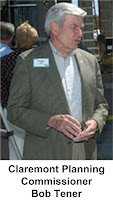 C. Freeman Allen (LWV member)
- Bob Tener (Planning Commissioner, former Architectural Commissioner, City Council aspirant)
- Gwen Carr (LWV member, Human Services Commission Chair)
- Bob Gerecke (LWV member, Claremont Democratic Club President, spouse of Katie Gerecke, former LWV President)
- Andy Winnick (Human Services Commissioner)
- Mary Noonan (LWV member)
- Sharon Hightower (LWV Member, former Planning Commission Chair, chair of the city's General Plan Advisory Committee)
- Helaine Goldwater (LWV member, former Police Commission chair)

Looking at the above names really underscores the main problem with the process for approving these sorts of projects. If you are an average citizen you are really competing on an unequal playing field in trying to have a voice in the process. Your voice is really worth less than half of any of the people listed above. (Odd to see Mary Noonan throwing in with these folks, but such are the times we live in.)
The process is inherently unfair because there are no checks and balances. In these matters, the Claremont 400 and their representatives act as proponents, legislators, and judges. That is why people are compelled to challenge the city in court or in elections (RECALL!, as was shouted out more than once Tuesday night).
THE LEAGUE ON THE ATTACK
 What's particularly odd about this case is the ignorance displayed by people like Winnick, Tener, Gerecke, Hightower, Goldwater, and the like. They've tried to take the main significant issue raised by the EIR - the fact that there will be unavoidable hazardous environmental impacts to children growing up on the Base Line site - and frame that as if it were an invalid argument raised by the project opponents.
This is, of course, a lie. The environmental concern about the site was NOT created by the people opposed to the Base Line project. The issue was raised by the city's EIR and by the USC Keck School of Medicine study that found children who lived within 500 feet of major highway had a much higher likelihood of impaired lung development.
When speakers like Mary Noonan get up and say that their children grew up next to the 10 Freeway and that their lungs are just fine, they think they're criticizing the project opponents. However, they are really taking on the USC Keck School work, which was a 10-year, peer-reviewed scientific study involving 11,000 children and published in the British medical journal The Lancet in February, 2007.
To someone watching from the outside, Noonan and the others sound every bit as ignorant as Flat Earthers in their remarks. We seriously doubt that Noonan or Winnick or Goldwater have spent 10 years, as the USC researchers did, compiling data on lung development in their children.
Yet, the League and Claremont 400 proponents of this project seem to be arguing that the USC study was part of a grand conspiracy of Base Line Project opponents to defeat their well-intentioned plan for affordable housing.
Imagine the cunning it took for the USC researchers to plan more than 10 years ago to set about to undermine the Claremont affordable housing project, to apply for grant money for their study, to gather research subjects, to devote 10 years of research time, resources and energy to their devious plan!
The ignorance of Winnick, et. al., extends to other arguments. For instance, they blur the distinction that the USC study made between living within 500 feet of major highway and merely living in the vicinity. To the study authors, there is a very significant difference. That is why some of the study's authors have weighed in on the subject.
And, Winnick and the like say that since we've built such developments in the past, we should continue to, which is really the same logic as saying that since we allowed certain kinds of auto exhaust systems in 1949, we shouldn't have catalytic converters.
The League also falsely argues that the timetable for building the affordable housing project makes the alternatives impossible. They claim that if we were to switch to one of the other possible sites it would take much longer than sticking to the current plan. This is nonsense and quite the opposite of the real situation.
In reality, if the city doesn't go to an alternative plan, one without the environmental concerns of the Base Line Rd. site, they will not qualify for the grants the city is counting on to build the project - that is, after any litigation on the matter has been hashed out. All you have to do is look at the Padua Park project to see where such stupidity leads. Seven years after a similar fight, after litigation finally ended, the park has no outside funding and the city is having to build the project in stages.
So, we have to ask, does the League really believe that changing to an alternative site would take seven years? Of course not! For one thing, an EIR would likely not be needed, and there would likely not be the opposition there is to the current plan. But the path-of-least-resistance strategy is lost on the clueless League, whose members seem to take an almost sadistic pleasure in hammering flawed projects down the throats of the public.
The League and friends also like the Andy Winnick tactic of disparaging members of the public who disagree with him. On Tuesday night, Winnick said he found the arguments opposed to the project (which by extension includes the arguments of the SCAQMD, the USC researchers, LA County Supervisor Michael Antonovich's oiffce) reprehensible. What Winnick is really peeved about is that ANYONE would question his assumptions. There is no logic or reason at work here.
 THE EXAMPLE OF 2006
In the end, you can count on the League and the Claremont 400 will do as they always do: Turn on the opponents. They aren't just making bad arguments, the League says. They are EVIL.
In the 2006 Parks and Pastures Assessment District vote, they attacked opponents of the assessment saying that the claims of those people that they supported an alternative funding measure to buy Johnson's Pasture were false. The assessment proponents in essence called the opposition liars.
In that assessment campaign, the League, who just as they have done with the affordable housing issue, ran a large newspaper ad in support of the assessment. Further, the assessment proponents argued that the alternative, a bond measure, would never pass and that the assessment opponents would not work to help get a bond passed.
The reality was, after the assessment failed 44% to 56%, that a number of people who had opposed the assessment stepped up and worked with people they had formerly opposed and got a bond passed with a remarkable 72% of the vote in November, 2006. And many of the Claremont 400 people who had worked on the assessment - former mayors Diann Ring, Judy Wright, Al Leiga, Paul Held, and many others - were nowhere to be seen in the bond campaign.
So when the League and others claim that their affordable housing opponents are disingenuous in saying they support affordable housing at any other site but the current one, you have to take that with a grain of salt. There's the clear, recent example of Johnson's Pasture to show that people who've opposed one thing can turn around and work together to get an alternative accomplished.
If anything what that past example showed is the unreliability of the Claremont 400 when it comes to compromising and to working together with the larger community to achieve the consensus the League is always prattling on about.
This is where a community relies on its elected officials for guidance and leadership. The problem is that in the past the Claremont 400 has controlled all of the levers of power so that any compromise was impossible. Whether or not that control is as monolithic as in past years remains to be seen.
COMING UP: The Insider is at work on more video from Tuesday's meeting, including plenty of footage of a sour Andy Winnick so that you can see for yourself just how humorless and angry he can be.
Subscribe to:
Posts (Atom)

 Posts
Posts


