Claremont Insider

Saturday, January 19, 2008

David Allen on Art and Vanished Places

David Allen had a profile of Claremont artist Karl Benjamin in his Daily Bulletin column:

A Chicago native who went to college in Redlands after his World War II service, Benjamin became an artist by accident while teaching sixth grade in Bloomington in 1949.

The principal told him that besides math, English and the like, he had to teach art for 45 minutes a day. Benjamin had no clue what to do.

"So I passed out paper and crayons and told them to do art," Benjamin recalled. "They drew the usual stuff, cars and mountains and trees. It was really boring. So I told them to just do colors."

Inspired by the results, Benjamin went to the library and got art books. Modern art really grabbed him. He bought paints and began imitating artists he liked: Miro, Picasso, de Kooning, Pollock.

"Which is a pretty good way to learn," he remarked. "You choose your teacher."

He had early success, culminating with a 1959 show, "Four Abstract Classicists," in which he was one of four artists. It began at the L.A. County Museum of Art and traveled to San Francisco, New York and London.

Allen also blogged about bygone places in the area in a post called "Things That Aren't Here Anymore:"

Bill Ruh wrote me a nostalgic e-mail which became the main topic of today's column. He recalled past department stores and restaurants of his Inland Valley youth, places like W.T. Grant's, Berger's and the Rockette.

The discussion thread had over 75 comments, and you'll find a lot of people chiming in with their own memories of the past. If you're interested in all the changes going on in Claremont these days, you might want to take a look at Allen's post.

Friday, January 18, 2008

Long Live the Queen!

A New Year means there will be a new mayor in a few short months. Employees at City Hall are quaking in fear of the next mayor, Ellen Taylor, who's been licking her chops at the chance to lord her power over the peons toiling in the fields of the Planning Department, the Human Services Department, the Claremont police force, and every other other city agency.

Assuming she has the support of two of her fellow councilmembers, Taylor will take over the mayor's office from Peter Yao. Last year, Yao, made a deal with Taylor's people that allowed Yao to retain the mayor's post for a second year so that Yao could preside over Claremont's Centennial. In return, Taylor gets to be mayor this year so that she can use the position to run her re-election campaign for 2009.

Taylor has something of a reputation for imperiousness and arrogance and has rubbed a lot of folks, even some of her own supporters, the wrong way. The thinking here is that, as she did at the January 8th city council meeting, Taylor will use every opportunity she can to make her petty power plays.


Ellen Taylor shows off her winning ways. Let's see that again!

In preparation for her coronation, Taylor has been busying herself commissioning a sceptre and signet ring for the office.

We have be unable to confirm if Taylor intends to call in all the nobles in the Claremont 400 and the Claremont League of Women Voters and have them pledge their fealty. Taylor has also been rumored to be mulling over abolishing elections and installing herself as "Mayor for Life."

Expect her to try to silence public critics and to take the mayorship back to the days of former mayor Paul Held, who was known for his temper and for turning beet red if he heard something he didn't like.

While she waits to assume the position of mayor, Taylor has been getting fitted with all the accoutrements of power.

Lookout, Claremont!


LEFT: Claremont Mayor Pro Tem Ellen Taylor prepares to take the reins at City Hall, beginning with a fashion makeover. Taylor to be addressed as "Ma'am," reserves right to coin currency bearing her image.

Thursday, January 17, 2008

A Mighty Wind

No, we're not talking about another city council meeting.

Last night's Santa Ana winds were especially strong around Claremont. A check of the MesoWest ROMAN weather site showed that at the weather station at L.A. County Firestation #62 at Mills Ave. below Mt. Baldy Rd. sustained winds really started picking up after 5:40pm yesterday.

The winds weren't anything like the 82 mph gust measured at the Fremont Canyon station in Orange County or the 100mph peak wind at Laguna Peak in Ventura County, but they were still high enough to damage roofs and knock down tree limbs.

Sustained winds at the Claremont firestation reached 23mph after 9:30 last night. Peak gusts were above 40mph for several hours until around midnight and reached a high of 49mph between 8:40 and 9:40pm.

Click on Image to Enlarge

Claremont's Finest

Centinel over at the Foothill Cities Blog noted that the Claremont PD was hard at work this past week.

Centinel picked up on a Daily Bulletin article about the Claremont PD ticketing motorists who honked their horns in response to anti-Iraq War protesters at Indian Hill Blvd. and Arrow Hwy. last Friday.

According to the article:

Each Friday afternoon since the 2003 start of the war in Iraq, about 20 people - most holding signs with anti-war slogans - have congregated at the intersection to protest U.S. foreign policy.

The protesters are often encouraged by passing motorists who honk their horns or wave in support.

On Friday, police ticketed three of those motorists, alleging excessive honking.

Police say the honking was creating an unsafe environment. The protesters dispute that it posed any danger, with vigil coordinator Jim Lamb claiming that "police cars racing out" in order to ticket motorists was more hazardous.

"I was kind of amazed that they saw the reality there - that we'd been living with all this time - as suddenly a dangerous situation," Lamb said.

Claremont police Capt. Gary Jenkins said police responded to the intersection Friday after officers were flagged down by a person who felt the situation at the intersection was "becoming dangerous and unsafe."

Police issued tickets only to drivers who laid on their horns through the intersection, not those who beeped briefly in support, Jenkins said.

"Our focus is on the traffic safety," Jenkins said. "We are not focusing on any group or cause. It's completely irrelevant."

A reader also sent us a link to the Bulletin article, saying:

What! The Claremont police don't have enough speeders to contend with so now they have to ticket honkers? [Claremont Police Chief Paul] Cooper is a joke!!


The Claremont Courier also had an article on the ticketing. One question: What constitutes excessive honking? Sounds like U.S. Supreme Court Justice Potter Stewart's definition of hard-core pornography: "I know it when I see it."

Or in this case, hear it.

According to the Courier's article, by Tony Krickl, some of the motorists plan on fighting their tickets in court:

Duane Welsch also received a ticket for excessive honking. She was told that complaints had increased about the noise and that honking posed a safety hazard for students wanting to cross the street.

“It wasn’t apparent that there was a safety hazard,” Ms. Welsch said. “It just seems ridiculous to me.”

Those who were cited hope to work out an agreement with city officials to get the tickets rescinded. If no agreement is reached, they plan to fight the tickets in court because they believe that the citations violate their freedom of speech or were unclear on defining the terms of “excessive honking.”

Good luck challenging the tickets using the freedom of speech defense. This is the Grand Duchy of Claremont, not the U.S. We've all seen how much respect the city and City Attorney Sonia Carvalho have for the First Amendment.

Wednesday, January 16, 2008

Mismanaged Risk

PAST IS PROLOGUE

We've written quite extensively over the past several months on the affordable housing project on Base Line Rd. We've chosen the issue because we feel it offers a perfect case study for what has gone wrong in our local decision-making over the past 20 years.

Whether it's fiscal policy, police policy, parks and recreation policy, redevelopment policy, maintenance policy or employment policy, the same factors in mismanagement by city staff, elected and appointed officials, and the social network that ties them all together have been at the heart of all our various crises.

It's been very easy to predict the actions that staff, city officials, and the Claremont 400 will take because they have the same kinds of actions again and again in the past. As the saying goes, "Fool me once, shame on you; fool me twice, shame on me." Or, "The definition of stupidity is to do the same thing over and over again and expecting a different result."

Still, we have to wonder, what sort of growth as a community is it going to take to break out of this stupid cycle?


RISKY BUSINESS

On Monday we wrote about the lack of understanding of risk that clouds the arguments of proponents of the affordable housing project. The proponents, groups like the Claremont League of Women Voters or individuals like Claremont Democratic Club president Bob Gerecke and Human Services Commissioner Andy Winnick (more on the apoplectic Mr. Winnick in future posts), have criticized opponents who feel that the Base Line project should be moved to a different site because the project's Environmental Impact Report found that the site's proximity to the 210 Freeway will present hazardous pollutant impacts to children.

We find it odd that Winnick, Gerecke, and others who are nominally liberal Democrats in their politics would so eagerly abandon the environmental plank of their party's platform to push this project through. But, as we've said again and again, this sort of hypocrisy is what undermines the credibility of Winnick, et. al., in this particular instance and the Claremont 400 in general.

The ease and willingness with which they contradict and abandon previous positions is why such people cannot be believed. This capriciousness underlines the lack of rational thought involved in their positions on this and other issues. Measured against their own words, they are inconstant, emotional, and insincere - some of the very things they attribute to their opponents.

Winnick and others in the January 8th Claremont City Council meeting railed against the opposition to the Base Line Rd. project in condescending, patronizing and mocking voices. Worse, not only did they choose to ignore the weight of considerable scientific and medical evidence (a 10-year long study by the USC School of Medicine involving 11,000 subjects), but they pretty much called anyone who use such evidence in their arguments ignorant and racist.

In their arguments, Winnick and other proponents of the Base Line Rd. project say that it is not for the city of Claremont, the project opposition, the USC researchers, or anyone else to determine what risks the future affordable housing tenants should take. Winnick and company say that it should be up to each individual tenant to decide for themselves.

It is this Winnickian point that we find most hypocritical of all. One of the main complaints of Democrats with our current economy (Winnick, an economist, should know this) is that the burden of risk has increasingly shifted to individuals, away from employers and away from the government.

Private corporations, for instance, are requiring employees to pay ever larger portions of their health insurance (if it's even offered). And the private retirement pension is pretty much a thing of the past. Employees have to fund their own 401(k)s or other individual retirement accounts.

Or consider the debate over privatizing Social Security. Conservatives argue that individuals would be much better and much more efficient at managing their own investment risks than the government. Liberals, on the other hand, say that Social Security is supposed to be a safety net, a kind of insurance policy, and that it's best managed by the government in the safest, lowest risk sorts of investments.

Yet, in this one particular, local project, the local League of Women Voters, Winnick and the rest - who are all on the liberal to moderate end of the political spectrum - are making the argument for less government intervention (except for construction money) and much more individual risk.


REVERSED PSYCHOLOGY

We've been left puzzled by the upside-down world that Winnick and the League have been inhabiting. However, we did manage to find some very useful scholarly advice written in October, 2004, that helps us understand or at least recognize such hypocrisy. The essay we found discussed the need for students to think critically when evaluating information:

By Critical Thinking I mean developing the habit, the routine reaction, to question everything one reads or is told -- and to do so from two perspectives:

First, we have to train our students to always ask – “What is the veracity of the author or speaker?” – which itself has two aspects:

  • Does the person have an agenda, is s/he likely to be trying to persuade in support of some cause and how likely is the person to be shading the truth in support of that cause? – and

  • Even if the person is attempting to be honest and “objective”, even if the person thinks s/he is being “scientific” or as the principles texts call it thinks s/he is “practicing Positive theory” – nevertheless, we have to train our students to ask: “What is her/his ideological perspective?” – “Where is s/he coming from?” – for we must all understand, and we must teach our students to understand, that no one is truly objective.
Good advice from a professor of economics and statistics, to which we might add the question, to what extent are the speaker's words consistent with past statements and positions?

The author of this piece? Andrew J. Winnick, California State University, Los Angeles.

Tuesday, January 15, 2008

Off the Beaten Path

Meg over at M-M-M-My Pomona was away on a visit to northeast Ohio and was posting from afar. She had a very interesting bit on smoked meats and sausages and the Slavs of that part of Ohio.

That reminded us of a place we found a few months back off Pearblossom Highway (Hwy. 138) near Palmdale.

Valley Hungarian Sausage and Meat Company is located at 8809 Pearblossom Hwy. in Littlerock, CA. It's one of those places like the jerky and fruit stands that you're likely to pass by. But you don't see many Hungarian food places, especially in Littlerock, and it being lunchtime, we stopped in for a look.

Valley Hungarian is in a small building about the size of a rural general store. They do, as the name suggests, make their own sausages and smoked meats, and they have a large glass refrigerated deli case displaying their wares.

Valley Hungarian also stocks some products of Hungary, including jars of sour cherries in rum, sauerkraut, pickles, paprika, and many other things. They also make some pretty good sandwiches using their meats. If you've been out wandering the desert, as the Insider staff is known to do, this is a decent place to stop in for a bite to eat.

We found a mini-review of Valley Hungarian on Chowhound:

For sandwiches and the like, take a trip to Littlerock and head to the Valley Hungarian Sausage & Meat place on Pearblossom. Great pastrami, and I always pick up some fresh homemade andouille while I am there to make my great big pot of jambalaya. All sorts of meats, sausages, cheeses, spices (great paprika to be had here!) and other miscellany are up for grabs. If you're the two-wheeling type, it's the perfect stop after a long day in the canyons and on the dam.
They have an online list of their meats and list which ones are homemade. We're sorry we missed the paprika bacon.

If you find yourself having to go to Palmdale or Lancaster, try foregoing the 210 and go the back way. Hwy. 138 has been widened to Littlerock and is supposed to be much safer now. It actually seemed faster to us than going up to the 14 along the front of the mountains.


Valley Hungarian Sausage and Meat Co.
"Sausage Lover's Paradise"
8809 Pearblossom Highway
Littlerock, CA 93543
(661) 944-3351

Condo Projects on Hold

Will Bigham reported yesterday in the Daily Bulletin that four condo projects in Claremont are now on hold after being approved last year.

The projects were to be located on College Ave. at the old Claremont Courier building property, at the Old School House site at Indian Hill and Foothill, and along Base Line Rd.

The downturn in the housing market has apparently slowed condo sales way down, and the developers are worried about the units sitting on the market. One developer, the Olson Company, is trying to work out a cost-sharing deal with the city for the College Ave. project, according to the Bigham article:

Mayor Peter Yao said the Olson Co., slated to develop the 67-unit College Walk at the Village development on College Avenue, approached the city about setting up a cost-sharing arrangement before beginning construction.

That development, in the works for more than two years, is on hold indefinitely, said Tony Nguyen, Olson Co. director of acquisitions.

Assistant City Manager Tony Ramos said the city is doing a financial analysis of the Olson Co.'s cost-sharing proposal and will present the idea to the City Council for consideration.


The poor housing market seems to be causing lots of folks seem to be jumping on the city dole for their construction projects. The developer for the affordable housing project on Base Line Rd. may be trying to get additional funding from the city to help underwrite that proposal.

Before last week's city council meeting to certify the project's Environmental Impact Report, the council held a closed session meeting with the developer, Mark Gelman of Enhanced Affordable Development. The matter listed for discussion was "Price and Terms."

No reportable actions came out of the closed session meeting.

Monday, January 14, 2008

Parsing a Train Wreck

CERTITUDE

As we've remarked previously, observing the debate over the Base Line Rd. affordable housing project one sees these things unfold with the inevitability of a train wreck, gathering a momentum all their own.

Rationally, we'd step back, sit both sides down, and work out a compromise. Claremont, however, is held hostage on this issue and many others by a certain kind of moralizing self-righteousness on the part the people who control things - the Claremont League of Women Voters (LWV), the Claremont 400, and many members of the City Council and city commissions.

The moral certitude with which this power group conducts itself approaches a religious fervor and precludes any reasonable compromise, as we hope to illustrate with this post.


GAMING THE SYSTEM

What generally happens with something like this affordable housing proposal is that an idea gets floated - We need affordable housing. There's a site on Base Line. We're going to build it there! - before any real analysis is done.

Because the LWV and Claremont 400 spend so much time talking to themselves rather than people outside their group, the initial idea quickly becomes set in concrete without any contrary information being allowed into the pre-public decision making. The views of important stakeholders, such as people who actually live near the proposed projects, are overlooked. The thing becomes a done deal, and only then do the public meetings begin.

And in the meetings (that precious "process" the LWV loves so much), the LWV and Claremont 400 work with city staff ahead of time to stack things in their favor. For instance, in the Padua Sports Park environmental impact report (EIR) hiring a person who falsely indicated he had a Ph.D in biology to do the biology section of the report (the Ph.D was in theology and was purchased for $100 from the Universal Life Church). Naturally, the biology report found there would be no significant impacts caused by the project, even though the California Department of Fish and Game and the U.S. Fish and Wildlife Service submitted opinions to the contrary.

Because the League and the 400 control virtually every commission and committee in town, they are able to plant landmines a long time ahead that prevent or preclude certain arguments against projects. For instance, LWV member Sharon Hightower, who is also a former Planning Commissioner, also chaired the City's General Plan Citizen's Advisory Committee. The LWV and the General Plan Committee made sure to plant geographical distribution as one of the goals for affordable housing. This meant that finding a location for affordable housing North Claremont automatically became a requirement. Since there the League was already pushing for the site on Base Line Rd., they could now argue that there were no alternatives to the Base Line Project that met the city's goals - goals written by the LWV.

(Hightower's General Plan committee did a similar thing with Padua Park, recommending rezoning the old Holliday Rock gravel pit at Base Line Rd. and Padua Ave. from open space to a mixed-use designation. They seemed to do this in order to remove the Holliday pit, which is a superior to the Padua site, as an alternative to the the Padua Sports Park project.)

Hightower and the LWV do these sorts of things because they have a much better understanding of the process than the average citizen. They do control it after all, and they use their mastery of the process to their advantage. Councilmember Ellen Taylor did the same thing at the January 8th City Council meeting when she tried to get the council to certify the Base Line Project EIR while also removing from consideration any of the superior alternative sites.

Unfortunately, the League and the 400's gaming of the system also works to greatly increase the average citizen's distrust of the League and the city. Worse, or better depending on your perspective, their actions diminish their own credibility and legitimacy.


FALSE ARGUMENTS

What makes the process even more unfair is that the two sides of the debate are frequently held to two different standards. For the LWV and the Claremont 400, there is one standard in which anything they say is accepted as gospel. For their opponents, on the other hand, no amount of factual information matters. The opponents will always be wrong. They are so wrong, in fact, that we don't have to listen to them at all.

Saturday's Claremont Courier noted a good example of this. Karen Vance, the League's lead person for affordable housing, spoke at the January 8th council meeting. (Vance spoke during the general public comment period at the beginning of the meeting and did not address the actual Environmental Impact Report issues for the project, so she wasn't listed in our catalogue of League-affiliated speakers.)

Vance in her comments addressed concerns of people whose kids go to Condit Elementary School. The Condit parents are apparently worried that because the kids from the Base Line Rd. project would go to Condit, leading to possible over-crowded class rooms. Because Condit is a higher performing elementary, it's a desirable school for some parents in the Claremont Unified School District. But, the thinking goes, with the affordable housing in place, kids who are currently there on an intra-district transfer might not be allowed in at Condit in the future.

Condit parents are also concerned about class sizes becoming too large if kids from the affordable housing and other proposed Base Line Rd. developments end up at Condit. Vance, however, said last Tuesday that she had met with CUSD Superintendent David Cash and that Mr. Cash had assured her that there were going to be no adverse impacts to Condit from the Base Line Project. The Courier article stated:
Another speaker, Karen Vance, a low-income housing advocate for the League of Women Voters, said she had assurances from Claremont Unified School District Superintendent David Cash that Condit Elementary School had enough space for all the additional children that were brought into the city by the affordable housing project and other housing developments along Baseline Road. She also said no child would be transferred out of Condit Elementary due to the influx of new students.

In her comments, Vance mentioned Cash several times, saying in her opening remarks, "Superintendent Cash understands these fears..." Cash, however, seemed to dispute Vance's characterization of his meeting with her, the Courier said:
“Karen Vance does not represent me or the Claremont Unified School District,” Superintendent Cash said, when reached by phone on Thursday. “We are gladly willing to teach every child living in the district, but there is absolutely no way to guarantee placement of students at any of our schools … We have standard guidelines for doing that.”


If the Courier had not bothered to contact Superintendent Cash, Vance's statements would have stood as fact. Given the way things work in town, they may still stand as truth. But, we now have reason to question Vance's veracity on this point.

Watch the video of Vance's remarks and note the certitude with which she speaks. Further, watch as a clearly emotional Vance frames her opponents as being afraid of facts, as using fear to keep the Base Line Rd. project from going through. She really seems to be calling people opposed to the project bad people. It's not enough that their arguments are incorrect:


Karen Vance speaking at the 1/8/2008 council meeting at the Hughes Center as Citizen Michael John Keenan and others look on.


REAL RISK

We were a bit surprised by Vance's speech last week. Vance has in the past struck us as being fairly level-headed, moderate, and at least willing to listen fairly to opinions other than her own. But given Superintendent Cash's quote, she was far from on solid ground in her comments last week.

Vance, in relating her meeting with the superintendent, invoked the word "reason" several times, and at one point said, "We have just now learned the rational, objective facts." She went on to make a point of telling the council that it was her fear-mongering opponents who were the irrational ones.

Yet, Vance and the League have continued to ignore the rational, objective facts presented in the EIR for the Base Line Rd. Project. Facts like those from the USC School of Medicine's study which, we have noted again and again, are the result of a 10-year, peer-reviewed research study published last year in The Lancet medical journal.

No one made the results of those studies up or mischaracterized them. No affordable housing opponent worked on the study's report. Those findings state that children living within 500 feet of a major highway will have a higher incidence of impaired lung development. Period.

So, it's simply a lie for the League to continue to say that everyone in the Claremont area faces the very same risk. The USC study clearly distinguishes between the risk of a 500-foot or less proximity and living outside that distance from a freeway. Within 500-feet of a freeway equals a much higher risk than farther away. The risks are not equal.

Additionally, the League and other project proponents have a peculiar and flawed notion of the risk involved here. They keep arguing that it is not up to us to decide for the potential project residents whether the risks are tolerable or not. They also say that the risks can be avoided by getting the project residents to sign waivers of liability. However, the risk here is not the future residents' risk.

The risk everyone, including the League, is talking about is the risk of future litigation the city would assume by building this project. And the idea that a waiver would protect the city is false. The risk here is really no different than the risk the city took on when it took ownership of the wilderness park, and we all know what happened there in 2003. $17.5 million is an awful lot to pay for underestimating or ignoring a risk.

In this case, City Attorney Sonia Carvalho knows that in California a parent cannot sign away a child's right to sue. Why she does not correct this misapprehension is a mystery.

And the League's claim that mitigation for the pollution hazard can be provided in the form of air filters has two obvious flaws. First, as USC researcher Ed Avol wrote in a letter to the Courier, there is no guarantee that the filters would be maintained. Second, people living in the units would become virtual prisoners under the League's proposal. They would not be able to go outside or to leave their windows and doors open. They would live in hermetically sealed bubbles (which, come to think of it, is kind of how the League operates).

No, it's time for the Vance and the League to set aside their emotions and to look at alternative proposals, which are the only real, rational choices that can be made. No matter what the League may think of people who have voiced opposition to the project, the environmental concerns raised by the city's own EIR for the project cannot be easily ignored or cast aside.

Sunday, January 13, 2008

Wayland Court Floods

Last weekend's big rain reportedly caused a Metrolink drain to back up and flood three homes on the south side of the railroad tracks just east of Mills Ave.

The Claremont Courier had an article on the flooding and also noted that three additional homes had garages flooded. The article also noted that the are had similar flooding in 2003.

Metrolink appeared to be seeing to the repair work at the affected homes.

Upon Further Review

Yesterday, we posted an email we got from Vanessa Hua, the author of the San Francisco Chronicle travel piece on Claremont.

We also received this email from April Economides, who like Ms. Hua wanted us to know that the Chronicle piece was not part of the city of Claremont and Chamber of Commerce joint PR campaign.

However, Economides also wrote that the Chronicle article was the result of her own PR work while she was publicist for the Claremont Museum of Art and the Hotel Casa 425 in the Claremont Village Expansion. Ecomonides said that she pitched the story idea to the Chronicle and was also responsible for last year's Huell Howser KCET video pieces on Claremont, as well as other news bits that about Claremont that appeared on CNN and in print media.

Economides wrote that she had no hand in the content of the pieces, which she said was left up to the news outlets. We thank her for that clarification. It does seem to verify our initial reaction that there had to be someone pushing all these stories on Claremont.

We understand the need to gin up business for all these new enterprises going in downtown. Our beef with these sorts of PR efforts is that that they gloss over the real issues in Claremont - for instance, the concern that the changes brought on by the Village Expansion will end up destroying the feel of the old Claremont Village. Further, all this PR noise gives the folks in the Claremont 400 cover to avoid confronting those issues.

April Economides is the founder of the public relations firm Green Octopus. Here is her email:

Hi there,

I saw your post about the SF Chronicle article and wanted to let you know that it actually was not the result of the Chamber/City’s PR effort. I pitched the travel story on Claremont as part of my work as the (former) publicist for the Claremont Museum of Art and Hotel Casa 425 (‘former’ because I’ve retired my PR hat to enter a full-time MBA program). I also landed the Huell Howser shows on the Packing House and Folk Music Center, the recent CNN segments, and many of the regional/state magazine/newspaper articles within 2007, none of which involved City or Chamber efforts.

When I pitched travel stories on Claremont, nearly every editor I talked with said they were uninterested in doing a story on Claremont because they did one three/ten/whatever years ago. What they were interested about were the new things about the city, like the packing house and museum, for example. This is of course natural, since media usually report on new things. But while my city-wide pitches included the museum, packing house, and hotel, it’s important to understand that most of the bizs/orgs/great places I listed as examples for editors were existing ones (like Some Crust, Harvard Square Café, RSA Botanical Garden, etc.), and I emphasized the city’s quaint village, historic architecture, trees, and great pedestrian life above all else.

It’s a PR person’s job to pitch story ideas, but the media decides what to publish. I know that small local papers don’t always follow these ethics, and sometimes even huge ones (like with national politics!), but, thankfully, this was the case with all of the publicity I mentioned above. My pitches have never mirrored the end result, and I’m happy, because it means the media has done its job by thinking for itself vs. letting me craft the story. Travel pieces in particular bring disappointment to people who know a place, since it’s entirely based on the writer’s tastes and opinions, which of course are unique. I never agree with everything a travel writer recommends.

All of the recent publicity on Claremont brings people to the city that might not have otherwise visited, and these folks end up spending money in both the village and expanded area. For example, a lot of folks flocked to the packing house after the first Huell Howser episode ran, but many of them also walked into the original village and I’m sure spent money there too. Similarly, the Chronicle story will probably bring some new visitors into town and into some of the village’s cafes/shops/etc.

I can understand why you made the assumptions you did. Hopefully my email not only clears some stuff up but also helps you feel more positive about the recent coverage on the city.

Your fellow citizen,

April Economides

Saturday, January 12, 2008

Xavier Alvarez Update

Not to pile on, but Will Bigham reports in the Daily Bulletin that erstwhile Medal of Honor winner and Three Valleys Municipal Water District boardmember Xavier Alvarez faces an additional charge of a false Medal of Honor claim.

According to the article:

Alvarez made the newly discovered medal claim while he was a candidate for mayor in Pomona's January 2006 special election, said Craig H. Missakian, assistant U.S. attorney.

Alvarez's claim was recorded during a meeting with the Pomona Police Officers Association when he was seeking its endorsement, Missakian said.

Ontario's Super Wal-Mart Moving Forward

Claremont isn't the only city fighting its residents over a proposed development.

The city of Ontario, a few miles to the east of us, is planning on putting in a Wal-Mart Supercenter on the west side of Mountain Ave. at 5th St., just south of the 10 Freeway.

The project has gone through an EIR process, just as Claremont's affordable housing project is going through one now. As with Claremont's project, the city of Ontario was working with a private entity to try to shepherd the company through the EIR process, which has been completed.

Last year, Ontario's Planning Commission certified the Wal-Mart EIR, and the Ontario City Council denied an appeal by a citizen's group. The project seems to be rolling along, though some people are still trying to oppose the big box store.

Luckily for Claremonters, they're only fighting the Claremont 400, not a Fortune 500 company. Good luck to the folks in Ontario, Jib Jab at least has got your backs:

Corrections

We got an email from Vanessa Hua, the author of the San Francisco Chronicle article we poked fun on Thursday:

Thanks for taking the time to highlight my article. I enjoy reading your blog regularly.

However, I wanted to point out errors in your post. I'm not Riverside based. I live in Claremont, which the article states. Regarding your other concerns, please note that travel articles typically cover what is new in a locale and the village expansion and the hotel certainly fall under this criteria. There's no other agenda.


If you read the article closely you'll see there are several paragraph devoted to the "original" village, mentioning Viva Madrid, the Folk Music Center and more. In fact, most of the restaurants and all of the shops mentioned in the article are located in the village – not the expansion.

Best,

Vanessa


Our apologies to Ms. Hua. We got her Claremont location mixed up with her school, UC Riverside, which was listed on her website. Our mistake. We've corrected that.

As to our comments on her article, our original post said that "[Ms. Hua's] article pretty much centered on Village businesses," which it did. However, we could certainly see where the emphasis in the piece was on Old Village vs. Village Expansion.

Thanks to Ms. Hua for pointing out that the article was not commissioned by the city as part of its ad campaign. We had wondered when we saw the "Special to the Chronicle" note under the byline.

You can read Ms. Hua's article here.

As always, glad to clarify and correct any incorrect information.

Friday, January 11, 2008

League Maneuvers

TAYLOR POWER PLAY

As we noted in Wednesday's post, the Claremont City Council ended up certifying the environmental impact report (EIR) for the project. However, they only did so after two votes.

Councilmember Ellen Taylor made the first motion, which would have approved the EIR but which would also have removed from consideration any of the possible alternatives to the project. This was a power play on Taylor's part because if approved there would have been no chance of the project being moved.

Taylor's motion was defeated 3-2 (FOR: Taylor, Yao; AGAINST: Calaycay, Elderkin, Pedroza).

The second motion, which was approved 4-1 (with Calaycay dissenting), kept the alternatives available for future consideration.

Perusing the video for Tuesday night's council meeting, we counted a total of 32 people who spoke during the public comment on the project EIR. Of those, 22 were against the project and 10 for - more than a super-majority against putting the project on Base Line Rd.

What was more interesting than the numbers was the composition of the speakers. The people who spoke against the project were not members of Claremont's elite. They were average citizens. The proponents, on the other hand, were mostly all either connected to the Claremont League of Women Voters or they were city commissioners (or both). Among them were:
  • C. Freeman Allen (LWV member)
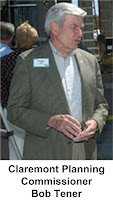
  • Bob Tener (Planning Commissioner, former Architectural Commissioner, City Council aspirant)
  • Gwen Carr (LWV member, Human Services Commission Chair)
  • Bob Gerecke (LWV member, Claremont Democratic Club President, spouse of Katie Gerecke, former LWV President)
  • Andy Winnick (Human Services Commissioner)
  • Mary Noonan (LWV member)
  • Sharon Hightower (LWV Member, former Planning Commission Chair, chair of the city's General Plan Advisory Committee)
  • Helaine Goldwater (LWV member, former Police Commission chair)

Looking at the above names really underscores the main problem with the process for approving these sorts of projects. If you are an average citizen you are really competing on an unequal playing field in trying to have a voice in the process. Your voice is really worth less than half of any of the people listed above. (Odd to see Mary Noonan throwing in with these folks, but such are the times we live in.)

The process is inherently unfair because there are no checks and balances. In these matters, the Claremont 400 and their representatives act as proponents, legislators, and judges. That is why people are compelled to challenge the city in court or in elections (RECALL!, as was shouted out more than once Tuesday night).

Moving the matter to court at least removes the city as final arbiter. Of course, litigation is never easy, but as the Palmer Canyon lawsuit showed, the city can be roundly defeated when the case is strong enough.


THE LEAGUE ON THE ATTACK

What's particularly odd about this case is the ignorance displayed by people like Winnick, Tener, Gerecke, Hightower, Goldwater, and the like. They've tried to take the main significant issue raised by the EIR - the fact that there will be unavoidable hazardous environmental impacts to children growing up on the Base Line site - and frame that as if it were an invalid argument raised by the project opponents.

This is, of course, a lie. The environmental concern about the site was NOT created by the people opposed to the Base Line project. The issue was raised by the city's EIR and by the USC Keck School of Medicine study that found children who lived within 500 feet of major highway had a much higher likelihood of impaired lung development.

When speakers like Mary Noonan get up and say that their children grew up next to the 10 Freeway and that their lungs are just fine, they think they're criticizing the project opponents. However, they are really taking on the USC Keck School work, which was a 10-year, peer-reviewed scientific study involving 11,000 children and published in the British medical journal The Lancet in February, 2007.

To someone watching from the outside, Noonan and the others sound every bit as ignorant as Flat Earthers in their remarks. We seriously doubt that Noonan or Winnick or Goldwater have spent 10 years, as the USC researchers did, compiling data on lung development in their children.

Yet, the League and Claremont 400 proponents of this project seem to be arguing that the USC study was part of a grand conspiracy of Base Line Project opponents to defeat their well-intentioned plan for affordable housing.

Imagine the cunning it took for the USC researchers to plan more than 10 years ago to set about to undermine the Claremont affordable housing project, to apply for grant money for their study, to gather research subjects, to devote 10 years of research time, resources and energy to their devious plan!

The ignorance of Winnick, et. al., extends to other arguments. For instance, they blur the distinction that the USC study made between living within 500 feet of major highway and merely living in the vicinity. To the study authors, there is a very significant difference. That is why some of the study's authors have weighed in on the subject.

And, Winnick and the like say that since we've built such developments in the past, we should continue to, which is really the same logic as saying that since we allowed certain kinds of auto exhaust systems in 1949, we shouldn't have catalytic converters.

The League also falsely argues that the timetable for building the affordable housing project makes the alternatives impossible. They claim that if we were to switch to one of the other possible sites it would take much longer than sticking to the current plan. This is nonsense and quite the opposite of the real situation.

In reality, if the city doesn't go to an alternative plan, one without the environmental concerns of the Base Line Rd. site, they will not qualify for the grants the city is counting on to build the project - that is, after any litigation on the matter has been hashed out. All you have to do is look at the Padua Park project to see where such stupidity leads. Seven years after a similar fight, after litigation finally ended, the park has no outside funding and the city is having to build the project in stages.

So, we have to ask, does the League really believe that changing to an alternative site would take seven years? Of course not! For one thing, an EIR would likely not be needed, and there would likely not be the opposition there is to the current plan. But the path-of-least-resistance strategy is lost on the clueless League, whose members seem to take an almost sadistic pleasure in hammering flawed projects down the throats of the public.

The League and friends also like the Andy Winnick tactic of disparaging members of the public who disagree with him. On Tuesday night, Winnick said he found the arguments opposed to the project (which by extension includes the arguments of the SCAQMD, the USC researchers, LA County Supervisor Michael Antonovich's oiffce) reprehensible. What Winnick is really peeved about is that ANYONE would question his assumptions. There is no logic or reason at work here.


THE EXAMPLE OF 2006

In the end, you can count on the League and the Claremont 400 will do as they always do: Turn on the opponents. They aren't just making bad arguments, the League says. They are EVIL.

In the 2006 Parks and Pastures Assessment District vote, they attacked opponents of the assessment saying that the claims of those people that they supported an alternative funding measure to buy Johnson's Pasture were false. The assessment proponents in essence called the opposition liars.

In that assessment campaign, the League, who just as they have done with the affordable housing issue, ran a large newspaper ad in support of the assessment. Further, the assessment proponents argued that the alternative, a bond measure, would never pass and that the assessment opponents would not work to help get a bond passed.

The reality was, after the assessment failed 44% to 56%, that a number of people who had opposed the assessment stepped up and worked with people they had formerly opposed and got a bond passed with a remarkable 72% of the vote in November, 2006. And many of the Claremont 400 people who had worked on the assessment - former mayors Diann Ring, Judy Wright, Al Leiga, Paul Held, and many others - were nowhere to be seen in the bond campaign.

So when the League and others claim that their affordable housing opponents are disingenuous in saying they support affordable housing at any other site but the current one, you have to take that with a grain of salt. There's the clear, recent example of Johnson's Pasture to show that people who've opposed one thing can turn around and work together to get an alternative accomplished.

If anything what that past example showed is the unreliability of the Claremont 400 when it comes to compromising and to working together with the larger community to achieve the consensus the League is always prattling on about.

This is where a community relies on its elected officials for guidance and leadership. The problem is that in the past the Claremont 400 has controlled all of the levers of power so that any compromise was impossible. Whether or not that control is as monolithic as in past years remains to be seen.

COMING UP: The Insider is at work on more video from Tuesday's meeting, including plenty of footage of a sour Andy Winnick so that you can see for yourself just how humorless and angry he can be.
Yao Turned Down for AQMD Seat

As we predicted would happen, Claremont Mayor Peter Yao's bid for the South Coast Air Quality Management District's Eastern Region seat was unsuccessful.

Yao, whose support of Claremont's Base Line Rd. affordable housing project has caused him to ignore the AQMD's recommendation that the project not be built on the Base Line site, really had no business throwing his hat into the ring.

Just another case of stupid, non-rational Claremont-centricity dooming a local politician's wider ambitions. Or you can just file it under the heading "Karma."

Crime Report

POLICE BLOTTER

Lots of crime news recently:


The Daily Bulletin noted that a woman was stabbed near Bonita and Oberlin yesterday as she was walking home from work. Claremont police arrested a suspect, transient Kai Cheng, a short time later on the 800 block of West 1st St.

The Bulletin article said that friends of the victim thought the assailant may have been trying to steal the victim's purse, though the police dispute that.

* * *

The Bulletin also carried a brief piece two days ago about a 23-year-old woman who suffered 2nd and 3rd degree burns while trying to set fire to herself in the Denny's Restaurant at 820 S. Indian Hill Blvd.

The woman apparently said the self-immolation was in response to her seeing the devil.

* * *

Also, back on December 8th, three men were convicted of attempted murder and assault for an an attack a year earlier on a black man who was stabbed during the altercation.

The attack, which has been called a hate crime, occurred near the Baker's Square Restaurant at Indian Hill Blvd. and San Jose Ave. According to the 12/22/07 Los Angeles Times:

Joseph Dale McCool, 21, of Yucca Valley; Anthony Scott Allen, 24, of Big Bear City; and Ryan Christopher White, 29, of Joshua Tree were convicted in a Pomona courtroom of attempted murder and assault charges in the Dec. 8, 2006, attack on Charles Washington.

The three are scheduled to be sentenced Feb. 1.

A fourth man, Chad Timothy Milson, 21, reached a plea agreement with prosecutors Thursday and received three years' probation, according to the court.


The attackers had stopped off in town on the way to a white-supremacist rally in Los Angeles when the incident occurred, the Times reported.

Thursday, January 10, 2008

Shop Claremont

Claremont's PR machine grinds on.

The city of Claremont in partnership with the Claremont Chamber of Commerce invested $84,000 a couple months ago in a print and TV advertising campaign to draw customers to the new Village Expansion.

Some of the older and non-Village businesses have felt the ads focused too much on the Village Expansion and didn't benefit Claremont as a whole, so they started their own business-owners group, the Claremont Merchants Association.

A number of our readers wrote it questioning the ad campaign as vapid and déclassé. They seemed to feel that the ads didn't really encompass the Claremont that they knew and loved, a Claremont that is rapidly and vapidly disappearing.

Quite independently of the Chamber PR effort, the San Francisco Chronicle picked up an article, written "Special to the Chronicle," that ran in the paper's January 6th travel section.

The Chronicle article, written by Claremont-based freelance writer Vanessa Hua, seemed as if it were commissioned by the Chamber and was pretty much centered on the Village businesses, talking about Three Forks Chop House and listing only one hotel, the new Hotel Casa 425, which has only 28 rooms and which seems to get its name from its room prices. Not necessarily the place the average Chronicle reader would go if they happened to be in town for a weekend. It seemed odd too, that the Hua would omit other non-Village accommodations like the Doubletree or the Hotel Claremont.

And Jared Cicon, the independent adman who was in the local news last year for entering a couple amateur TV ad contests for Doritos and Heinz ketchup, has been enlisted into the City-Chamber promotional campaign as well:


Blogger and former Claremonter Juliana Brint picked up on the Chamber ads and had a few comments:

speaking of city planning and douchebagery: i'm a big fan of claremont's village expansion HOWEVER its accompanying ad campaign (financed by the city) plays into the worst of southern californian tendencies: superficiality, vapidity and a heightened sense of entitlement. it implies that the only worthwhile part of claremont is the village (only one of the seven "points of interest" on the agency's website is outside the village). the campaign's slogans range from self-satisfied spoiledness ("mia needed couture jeans to go with her superiority complex") to the inane and inarticulate ("claremont: shop, dine... chill").

NOTE: When we originally posted this, we listed Vanessa Hua, the writer of the Chronicle travel article, as "Riverside-based." Ms. Hua actually lives in Claremont. She also has written in to correct us about any notion that her Chronicle piece was commissioned by the city or the Chamber. It was not.

Wednesday, January 9, 2008

Claremont Council Certifies Affordable Housing EIR

Mayor Pro Tem Ellen Taylor
vows to hold breath until council votes her way.


The nearly 6-hour council meeting last night ended with council almost as much in the dark as when it began (literally; the building lights went out 20 minutes after midnight, drawing the proceedings to a merciful close).

In the end, council certified the affordable housing EIR on a 4-1 vote (Calaycay opposing) after a more draconian certification motion by Ellen Taylor failed on a 2-3 vote (Taylor and Yao voting in favor, Pedroza, Elderkin, and Calaycay opposing).

The distinction between the failed motion and the successful motion is that the failed motion explicitly rejected two feasible alternatives; the successful motion preserved them to be considered at a later meeting.

Hughes Center was packed for this meeting. In a moment of the phony jollity for which he is known, Mayor Peter Yao early on invited dozens of students attending council on class assignment to leave the room and the building, assuring them that some city worker would sign their sheets for class. Our guess is that he knew what was coming and didn't want it to be exposed to impressionable minds. Of course, being good and obedient citizens, the impressionable minds rose from their chairs and left as one.

The people remaining were a little less good and a little less obedient. By our count, some 32 members of the public spoke and were divided roughly 2 to 1 against the EIR and the project.

Here is video of the first (unsuccessful) motion to certify the EIR and at the same time reject the alternatives:


Finally City Attorney Sonia Carvalho took charge and Council certified the EIR while at the same time preserving the feasible and environmentally superior alternatives for later discussion:

Demitria FOUND!!

The owner of Demitria, the friendly, short-haired, striped feline, reports that she has been recovered:

We had a phone call from a woman who found our cat up a tree in her back yard. Demitria is now back at home snoozing on the couch.
Stories sometimes have happy endings.

See here for the backstory.

Tuesday, January 8, 2008

Missing Pet

We received this note about a pet cat lost and last seen on Arrow Hwy. near Mountain Ave. There should be posters with contact information along Arrow and Mountain. The cat, Demitria, is five months old, short-haired, striped, with a heart-shaped collar with the owner's name and address information.

We'll keep this at the top of our postings for the next few days. If you know anything, please email us at: claremontbuzz@yahoo.com, and we'll pass the information on:

Hi,

I hope maybe you can help me or at least direct me to someone who can. Our cat disappeared on December 30 and tonight, January 7, we received a call from someone named Phillip who said he had seen our cat at Arrow and Mountain. Phillip said he was going to bring her back to our house, but when he put her in his truck she became upset and jumped out, ran down the street and hid from him. My cat has on a collar, her name is Demitria and our phone number and home address are on her tag. She is about 5 months old and she is very friendly. We are very upset about losing her as well as the phone call. Could you help please?